
Although goulash originated in Hungary where it is celebrated as its national dish, it also holds a cherished place in Slovak cuisine, reflecting the shared history and culinary traditions between these two nations. Many Slovaks relish goulash prepared both in home kitchens and restaurants, with each family often having its own unique recipe that showcases personal preferences and regional ingredients. In my opinion, the finest and most gratifying method of preparation involves cooking it outdoors over an open fire using a cauldron. For us Slovaks, goulash is more than just a delightful dish; it serves as a heartwarming social event, providing an opportunity to spend quality time with friends or family, where laughter and storytelling abound around the bubbling cauldron. This experience is a must for anyone seeking to immerse themselves in authentic Slovak culture. Traditionally, preparing goulash is an all-day affair, often taking at least five hours of cooking time, and it typically involves a fair amount of drinking as part of the process.
Ingredients 🛒
The ingredients for this dish may vary, especially when speaking about the types of meat. To start with, the best way to determine the ratio of meat and onions is to always measure it in volume. This can be explained by looking at a cut of meat and comparing it to onions cut into 0.5 cm cubes, where visualizing the portions becomes essential in mastering the technique. If you feel the amount is the same in volume as the meat that you are using, then you have it correct! Normally, the amount of ingredients is not so difficult; I prefer to cook with feeling instead of weight, especially for such traditional preparation that relies heavily on the cook’s intuition and experience. The process becomes an art form when one allows the senses to dictate the measurements rather than strict numbers. Obviously, the amount of ingredients depends on the amount of goulash that will be cooked, which can vary greatly depending on the occasion and the number of guests you intend to serve. There are many sizes of cauldrons; however, the content of this post was written using a 12-liter cauldron, making it an excellent reference point for larger gatherings. I believe it will be easy for you to convert to any size of pot or cauldron you will be using by applying the same principles. You can scale up or down while maintaining the essence of the dish. But without further ado, here I suggest this combination for the most optimal flavour.
The list ☑
- Pork belly (optional)
- Beef neck
- Onions
- Pork fat (or duck fat)
- Tomato paste / Concentrated tomato puree
- Sweet paprika powder
- Chilli powder / Hot paprika powder (optional)
- Black Pepper
- Garlic
- Yellow, red and orange peppers
- Peeled tomatoes (canned or homemade)
- Goulash seasoning (optional)
- Potatoes
- Marjoram
- Plum Jam

Preparation technique 👩🍳
1. Caramelise onions in pork fat.
This is the MOST important step of this preparation since the onions create a very distinct flavour as well as thicken the soup. The caramelisation needs to happen slowly, over very low heat; otherwise, the onions will burn. This will take a total of 75-100 minutes! Yes, it sounds hard. I can confirm from my past experiences that it is. Just a very small increase in temperature may burn the onions, creating unwanted flavour and texture in the soup. This is particularly the case while cooking on fire, where the temperature is rather unstable and may rise almost unpredictably.
By stirring actively and guarding the fire during the process you should go through this step without burning anything. I suggest seeking the help of someone more experienced. If that is not an option, my advice would be not to add a lot of wood at the same time and to ensure you have a strong and stable fire base before cooking; maybe even consider using coal instead of wood. It is also important to note that a strong fire can burn your cauldron, obviously depending on the type that you are using.
Furthermore, to finish this step, I recommend using an amount of pork fat that will almost completely cover your onions. If you don’t have pork fat (or you cannot use it due to religious reasons), using duck fat is also a good option. Normally, you can buy both at a butcher shop or just save some duck fat from your last preparation of duck breasts; trust me, there is enough in those. For reference, I provide a few pictures to better illustrate the process and the result of it.


2. In the next step, we will add concentrated tomato puree.
During my preparation, I used just one small can of tomato purée, typically found in supermarkets across Europe. If you’re making more goulash than I did, consider using 2 or 2 and a half cans; vice versa, if you’re making less, use a smaller quantity. After adding the purée to the pot, mix it with the onions for a while until the fat doesn’t separate. If you’ve ever prepared curry and fried it before adding other ingredients, this step might already be familiar to you. Frying it slightly is essential because “raw” concentrated tomato can introduce unpleasant sourness; however, burning it will make it bitter, which we want to avoid. I can assure you that by staying close to the pot and stirring properly, you can easily execute this step without any harm done.
3. Addition of red paprika. Do not burn it!
At the end of this process, we can add about 2-3 spoons of sweet red paprika. Traditionally, the best choice would be Hungarian paprika, but any good-quality paprika will do well. Using smoked paprika is also an option, but for the optimisation of taste, I wouldn’t recommend it, or at least mix it with some sweet paprika in a ratio of 1:3, respectively. We stir this for a very short time, just enough to incorporate it, because paprika powder tends to burn quickly.
4. Let’s cook some beef.
By adding beef cut into 4 cm squares, we will cool down the contents of our cauldron and thus prevent the paprika from burning. While occasionally stirring (still on low heat), we will wait until the meat changes color on each side. After this process is done, we can add water to just cover the meat. It is important to NOT boil the soup. The best would be to not bring it to a boil at all, but if that happens, just keep it gentle. Since we will cook it for some time, we don’t want the meat to become dry. The best way for meat (especially the ones with lots of connective tissue and fat) is to cook it slowly and lengthily.
For this recipe, I used some pork as well, and you can or don’t have to do that. The addition of pork meat adds a lot of fat and flavour to this dish, but in the next step, I will explain another way of getting the flavour in while using the meat in another simple dish later. If you are wondering about how much meat to add you can look at this picture for reference.
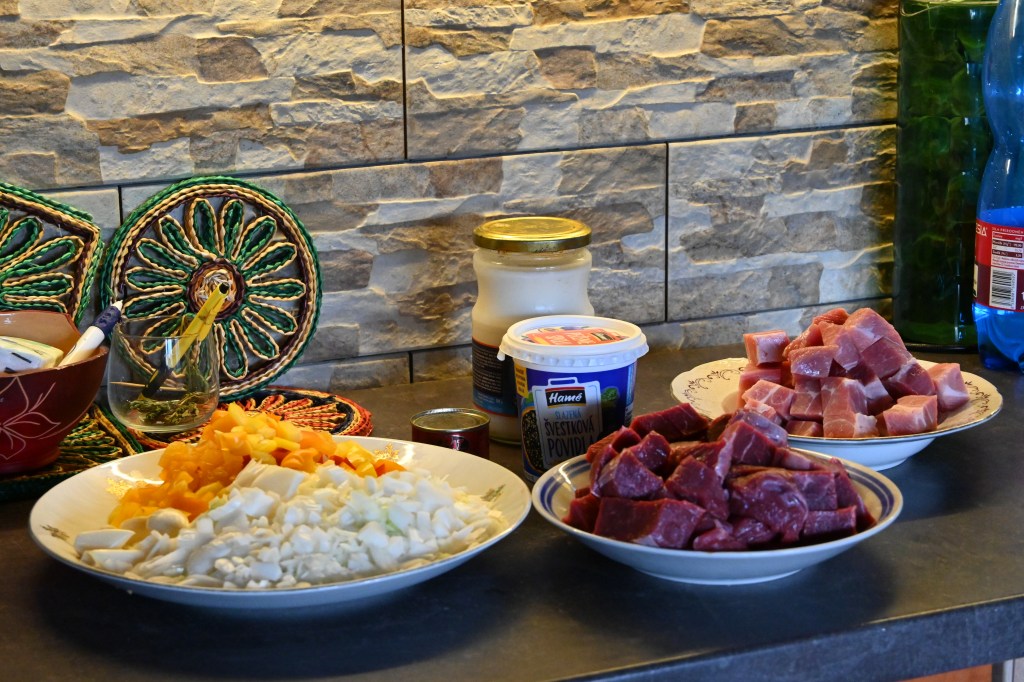

5. Making our own cooked bacon you say?
If you do not want to add more meat into your soup but you would love to have a distinct, rich flavour in your goulash, you can boil a full piece of pork belly in it. This method not only enhances the soup’s taste but also infuses it with a delicious, hearty essence that pairs beautifully with the other ingredients. You simply add the whole piece of pork belly into the soup right after you add the water, ensuring that it is submerged for optimal flavour extraction and even cooking. You cook it until the beef cubes are tender and fully cooked as well, which typically takes approximately 2-3 hours depending on the temperature of your preparation. During this time, the pork belly will release its fats and juices, contributing to a thick, aromatic broth that is undeniably comforting.
After the belly is cooked, you take it out and let it cool down completely. Meanwhile, you can prepare a flavourful mix of oil, minced garlic, salt, red sweet paprika (or smoked paprika), and chili if you want to add some spiciness to your dish. After you rub a thick layer of the mixture thoroughly on the belly, ensuring all surfaces are well coated, cover it with some aluminum foil to lock in the flavours. You can store it in your fridge overnight, allowing the spices to penetrate deep into the meat. The next day you can enjoy an explosion of flavours with your homemade bacon, ready to serve with other dishes of simply as a snack with bread and some mustard.
6. Adding our aromatics and spices!
Coming back to our soup, after we added the water we can add our veggies and the seasoning. First, we will prepare some peppers cut into small stripes; you can use any peppers. Obviously, the best would be to have some home-grown ones; however, if that is not an option, I recommend using different colors for more complex flavors and interesting color in the soup. We then add some canned peeled tomatoes. For a 12-liter cauldron, 1 bigger can will be enough. With this ingredient, you can of course use normal tomatoes as well; it would be better if they are well-ripened, and you have to peel them in water beforehand to remove the skins; otherwise, they will be quite annoying in the final dish. 3-4 bigger tomatoes will do just well. Additionally, we can throw about 3-4 cloves of garlic – peeled and smashed with the side of a knife.
Spices will be added afterwards: about 1 smaller spoon of black pepper, chili powder according to taste, and some additional red paprika if necessary. For a more optimal flavor in countries like Slovakia, Poland, or Hungary, you can find goulash seasoning in supermarkets. This is quite a common way to add this very specific flavour to your goulash. To have a better understanding of what I am talking about, look at this link. If you have it, use it; if not, that is okay as well. Of course, add the salt in this step as well!

7. Method for thickening the soup naturally.
After our goulash is cooked to the point that the meat is tender, we can start adjusting its quantity to achieve the perfect consistency. If you feel the soup lacks some juices or seems a bit dry, you can add some water to enhance its texture and bring back the moisture. On the other hand, if you find that the goulash is too liquid, you have the option to thicken it; or, of course, you can do both depending on your preference.
After you add water or if you simply think it is too thin, you can grind one or two potatoes straight into the soup. This will naturally thicken the goulash as the potatoes break down and release their starches, creating a velvety texture that enhances the overall flavour. Bear in mind that goulash should be quite thick rather than liquid, resembling stew rather than soup. Allow it to simmer for a few extra minutes, and you’ll find that this method not only thickens the soup but also adds a subtle creaminess. This is a great way to naturally thicken the soup while also elevating its taste.
8. Boiling potatoes 20-25 minutes before finish
Depending on the size of the potatoes we can add them in about 20-25 minutes before we are ready to serve the soup. This is very easy step and you have plenty of time to prepare the potatoes. you can just peel, cut them in squares and store them in a water unit they are ready to boil.

9. The finishing steps – marjoram and plum jam will make the difference.
Finally, you have some to the end of this recipe. After you cut the source of heat of the soup you can add a spoon or two of the plum jam into the this delicious mix according to your taste. You mix throughly to ensure its dissolution. This is a very traditional ingredients especially in the south of Slovakia, adding very specific sweet and cooked flavours to goulash. in the other parts it is not as common, so if you cannot find this ingredient just skip it without worrying your mind.
The last step will be to add 1 to 3 spoons of dried marjoram. It is not quite common herb to sell in many countries. you might find it in some polish stores for example. If you cannot find this you can search for an oregano which is the same family but has little stronger flavour. It is importune not to cook the goulash much after you add the oregano anymore. Some people believe that after storing goulash with marjoram it becomes more acidic overnight, and they suggest to put it in just before serving in your own plate, according to taste.