Tag: Travel

  • Travelogues of Japan #9 – the Hokkaido

    Travelogues of Japan #9 – the Hokkaido


    Day by day in Sapporo

    Day 71-72

    The first full day in Sapporo, we spent exploring the city. Our accommodation was right next to Nakajima Park, which was completely blanketed in snow. Of course, we couldn’t resist, we just had to build a snowman!

    After a beautiful walk in the park, we headed to Fog. Cafe, which is right next to a supermarket—later our main source of food.

    The café was fantastic, with a really cozy atmosphere, and they served sandwiches too. We had lunch there, trying the avocado sandwich and the maitake mushroom sandwich. Both were delicious!

    In the evening, we dove into the city’s nightlife and ended up at Bearfoot Bar, where we met a lot of international people and enjoyed some delicious fish and chips for dinner. We stayed out quite late and, let’s just say, had a little too much fun, so the next day, we decided to take it easy. Just chilling and Netflix sounded like the perfect recovery plan!

    Day 73

    The next day, we decided to go shopping and visited a lovely shopping mall located near the Susukino underground station. We spent most of the morning there and even grabbed lunch. For the first time in Japan, we decided to try Italian food. The place was called Le Varo, a kind of pasta bar. It was quite pricey, and we waited a long time for our order, but the pasta was surprisingly very good!

    In the afternoon, we planned to visit the Sapporo Beer Museum. On the way, we stopped next to Odori Park, where there was some sort of international Christmas market happening at the time. However, we didn’t stay long since we were waiting for a bus that took us directly from there to the museum.

    The building of the former beer factory was stunning. The best part, though, was that the museum was free to enter. We walked around, reading all the historical facts about the factory, and at the end, we had the chance to buy tasting samples of three different beers. The atmosphere in the tasting room was lovely, and the beer itself was excellent. I’d definitely recommend visiting this museum to anyone! There weren’t many people, but we still had to wait about 15–20 minutes for the tasting part of the exhibit.

    Day 74-75

    The next day was very calm, we mostly spent it working on our projects inside our accommodation. But at the end of the day, we went out for what I’d definitely consider a top 10 meal in Japan.

    The place was called The Medicine Man, and they served this amazing curry soup that’s very typical for Sapporo. We could choose from different types of soup: vegetarian, shrimp, chicken, or pork; and we were also able to pick our preferred spiciness level. It was absolutely delicious; we even considered going back the next day!

    The evening was quite eventful, we got a real scare from an alarm indicating a magnitude 7 earthquake in Japan. In Sapporo, we only felt a seismic intensity of 4, but it was still the strongest earthquake I’ve ever experienced. I have to admit, though, it was actually kind of exciting, it was one of those unexpected bucket-list moments!

    The next day, we did more shopping and stopped by a great burger place near Susukino called Shogun Burger. They had fantastic options, and it was relatively affordable, so we really enjoyed it.

    Day 76

    The next day was very exciting because we were traveling to Rusutsu. We took a bus from Susukino station (it was also possible to take it from near Sapporo main station) in the direction of Lake Tōya. It was a very convenient connection because it stopped right in front of the Rusutsu ski resort. It was necessary to book this bus in advance, by the way.

    The bus trip wasn’t very pleasant at the beginning due to a very annoying Chinese driver who almost didn’t let us in because he didn’t notice that we had already told him our reservation name. He noted it down but then forgot that we had already talked to him and didn’t want to let us in. Imagine how stressed we were when we thought we wouldn’t be able to get on a bus that we had already paid for. In the end, everything went well, and we enjoyed the most beautiful trip through the mountains of Hokkaido, which were so deeply covered in snow that even the branches on the evergreen trees were bending down under its weight.

    Overall, it was probably the best time we could have arrived in Rusutsu because, before our arrival, the snow conditions weren’t so good since the temperatures were above 0 degrees. One or two days after our departure, it was the same story, while the resort was also expecting more guests since the ski season was starting. Because of this, our timing was just perfect.

    Right after we checked into the Rusutsu lodges and unpacked, we had to go and explore the ski resort. It was very beautiful, but, in my opinion, a little bit too westernized and expensive. I guess that’s just how the resorts are nowadays.

    We also went to ask about our ski equipment and rental; we simply wanted more information about when it would be possible to pick everything up. We ended up paying for the rental (for 3 days of full equipment rental, we paid 11,000 yen per person) and trying on the clothes and ski boots in advance.

    In the evening, we ate at the Rusutsu lodges in a restaurant called The Red House. They had interesting and tasty options, and even a happy hour.

    Day 77-79

    The next day we went out early in the morning, picked up all the equipment, got dressed, and headed to the piste. We spent the first 3 hours just learning. I was the one who knew how to ski, and I was teaching my partner since it was his first time standing on skis.

    We also paid for the lift, which cost approximately 40 euros per person for the first two days at the beginning of the season, and the last day, when more lifts were open, we paid 53 euros per person.

    The next 3 days we spent learning how to ski; basically, most of the days we were at the slope. The piste itself was quite big. You can discover more about the options on the official website of Rusutsu ski resort. For a quick peek, I can provide a picture of the resort retrieved from here.

    Overall, Rusutsu was quite expensive compared to the rest of our Japan trip, but it was definitely worth it. Even the basics like eating out were double or even triple the price. Anyway, we still consider it one of the most fun activities we did in Japan together.

    Day 80 & 81

    The next two days we spent near New Chitose Airport, where we planned to take a plane back to Tokyo. We traveled the whole day, first taking a bus back to Sapporo and then going by train to our room near the airport.

    The travel by the domestic Japan flight was quite different compared to Europe, and I was confused more than once, but of course, in the end, everything went well.

    As we arrived in Tokyo, we checked into the Grand Hotel LDK. We chose this hostel because we had already stayed in it somewhere else in Japan and really liked it. We finished our day early since we were tired from the travel, but we were really looking forward to our last days in Tokyo and Japan.

    Day 82-83

    We then decided to visit Akihabara, the electric heart of Tokyo’s otaku culture. We wandered through the streets, surrounded by anime shops and gaming arcades. I was searching for a provocative manga T-shirt as a souvenir for my stepfather. It’s the kind of place where you could spend hours just soaking in the energy.

    One of the absolute highlights of my trip to Japan was finally getting my hands on a Japanese knife. If you’re into kitchen gear, Kappabashi in Tokyo is basically paradise. This iconic street is packed with shops selling professional kitchen and restaurant equipment, and the knife stores are next-level. I was on the hunt for a gyuto, and let me tell you, the craftsmanship is breathtaking. I’m still in awe that this beauty is now part of my collection!

    For food, we stumbled upon Bep Viet, a cozy spot serving up delicious Vietnamese dishes. The flavors were so fresh and vibrant, making it the perfect break from all the ramen we had so far. The atmosphere was warm and inviting, making it a great place to recharge after a long day of exploring.

    In the evening, we headed back to LDK Hostel and spent hours playing pool. It was such a fun, laid-back way to unwind, especially after all the walking and sightseeing. The hostel had a great vibe, and it was nice to just hang out and chat with other travelers.

    The last few days in Tokyo were all about soaking up the city’s energy. We didn’t have a strict itinerary, just wandering the streets, popping into random shops, and enjoying the little moments. Tokyo has this amazing mix of tradition and modernity, and every corner feels like a new discovery. It’s the kind of place that makes you want to slow down and savor every second.

    Day 84

    Our last day in Tokyo was a mix of final adventures and goodbyes. We started with the inevitable packing, which always feels like a puzzle, trying to fit all the items into the bags.

    Before leaving, we made sure to squeeze in one last Tokyo experience – we headed for okonomiyaki near Ueno Park. The savory pancake was the perfect comfort food, crispy on the outside and packed with flavor. Ueno Park itself was beautiful, even in the winter chill. The atmosphere was calm, and it was a nice way to soak in a bit more of the city before heading to the airport.

    Speaking of the airport, we grabbed a bite of Chinese ramen before our flight. It was a hearty, spicy bowl that hit the spot, an unexpected but delicious way to end our culinary journey in Japan.

    ***

    The flight back felt shorter than anticipated, almost as if Tokyo didn’t want to let us go. It was a whirlwind of a trip, but every moment was worth it. Until next time, Japan!
  • Travelogues of Japan #8 – Travel to the North

    Travelogues of Japan #8 – Travel to the North


    Day 57

    On this day, we started our 3rd part of the trip, which we generally called the Hokkaido part. The plan was to take a boat to Osaka and then slowly make our way up to Hokkaido from there.

    We took a bus from Kagoshima Chuo Bus Stop number 8 to the place where the boat would take us from. This shuttle bus was included in the fare we paid. We were booking through a company named Sunflower.

    In this boat, we planned to stay overnight. The price was quite high; we paid around 280 euros for the travel and one night for 2 people. This was, however, very similar to a trip by Shinkansen to Osaka. If you ask why we didn’t just go by plane, the reason is that I really dislike travelling by this means.

    The bus took approximately 2 hours, and after we arrived at the Shibushi port, we checked in at the check-in window. The surrounding was quite unexpectedly looking like an industrial port, and it smelled like dog food?! The boat itself was huge; I have never travelled by boat before (except for a short ferry trip, of course).

    The boarding itself was very fast for us as we were the first people to enter the boat. Right as we arrived, we were astonished by how beautiful it looked inside! The hallway with this beautiful staircase was in front of us, I felt like in titanic! We found our room easily, escorted by one of the crew members, and it was beautiful! We took a twin room because it was much cheaper than a double at the time we bought it. It was quite spacious and comfortable, very clean as well.

    We had to go discover the boat right after we dropped our bags in the room. There were quite a few facilities available, for example the restaurant, onsen style baths (where I couldn’t go at that time unfortunately), a souvenir shop where I bought socks with the Sunflower logo, but also a kids room, pets room, small game section, a vending machine room where you could purchase several brands of beer, and a lot of sitting spaces along the hall where you could enjoy the beautiful view.

    Of course, one of the first things we did was to visit the outside deck, which we were hoping would provide a view of the sea. At the time, we only saw an industrial area, though. I hoped to experience the feeling of being on the sea and not seeing anything but the horizon. The thing is that we boarded in the afternoon and by the time the boat left the port, the sun was slowly disappearing from our view, so as soon as we arrived at the open sea, it was completely dark. This was probably the only disappointment that I had on that boat.

    Around 20:00, we went to have dinner. We paid 2000 yen per person for a buffet-style dinner, so basically, all you can eat. There was a great range of different foods which we enjoyed a lot, accompanied by some beer. All the drinks except tea and water were paid for, though.

    It was dinner time, and I believed we arrived at the open sea because the boat started to move a lot. I was scared that I would be seasick, but in the end, it was all right. I was only a little bit dizzy at the beginning.

    After the dinner, we wanted to go out to look at the stars because of the lack of light pollution, but the outside deck was closed at that point. I think they didn’t want us to go out during the night, which was a little disappointing, but what could we do? So instead, we went to our room and slowly fell asleep to the soothing movements of the sea.

    Day by day near Fukushima…

    Day 58

    I woke up abruptly, around 6 o’clock, because of the sudden turn of the boat. I am quite sensitive to movements like this, and I got scared that the boat was crushed and was falling on the side, but of course, it was just turning to the Osaka port at that point. From that time we had around 1,5h to the arrival. The night was quite calm except for a moment in the middle of the night when I woke up because of a storm. Overall, the boat experience was one of the most exciting experiences in Japan for me, and I will definitely not say no to any future boat travels.

    When we arrived at the port, we had a lovely breakfast at the station, and then headed right to the Shinkansen. That day was very busy. We had to take a total of 2 Shinkansen and one bus to get to our next destination. We travel in total approximately 8 hours, and we paid 280 euros for that! But at least we finally saw the Mount Fuji on the way.

    It was a crazy and tiring day, but finally we arrived at a small onsen city around 30 minutes from Fukushima. The hotel we stayed in was called YUMORI Onsen Hostel. It was one of my favourite hotels we visited in Japan. The only unfortunate thing was that we took a bunk bed room that was shared with other guests because of its lower cost. We did not know it at the time, but this decision made us catch the flu or covid. We were staying in a room with a person who was coughing like he was about to die. And it was that evening that I started to have a throat ache and problems swallowing.

    That evening, we didn’t leave the hotel at all and spent our time reading in the lobby area, which was full of English books! I was so happy about that. We had some hot tea with pizza that was made in the hotel, and visited the beautiful onsen.

    Day 59

    The next day I woke up with a feeling that I would be sick. But it was nothing serious yet. I had some hot tea for my throat and spent most of the day switching between the Onsen and reading in the lobby.

    In the morning, we decided to have a small walk to a nearby footpath. It was very short, but the nature was beautiful, and in the end, you could enjoy some time in a natural hot spring to dip your feet in it.

    We also went for a nice lunch that day. We visited a restaurant called Hisago. It was a small restaurant specialised in soba noodles. They had this meal for 1300 yen, which was just amazing! The noodles were very good, and the small dishes consisted of mushroom tempura, tofu, perfect egg, a piece of egg tartine and carrot salad. The service was a little bit rude in my opinion, but otherwise it was an amazing lunch!

    At the end of the day, I felt really bad, and my whole body hurt. When I went to bed, I had a fever and had to take some medication to be able to fall asleep.

    My advice. I am not a person who eats and has a lot of medication, and I believe that many times a person can fight against a sickness without the need for drugs. But I have to say that it is really important to have some basic drugs if you travel. I would always recommend you to at least have paracetamol or ibuprofen, just in case you are in not accessible place and you fall sick. If you have a high fever and there is nothing around, there is not much you can do if you don’t prepare yourself for this scenario.

    Day by day in Yamagata and Aomori…

    Day 60

    The next day, it was time for us to move. It was a little bit uncomfortable when I didn’t feel good, but it wasn’t so bad. Actually, at that time, I thought that was the end of it and that I was getting better. I count myself far from the truth. After we arrived in Yamagata, we had to wait for about 2 hours before check-in, so we ended up walking outside in a nearby park in quite cold weather.

    We visited the park, which had these beautiful autumn colours. The trees were almost completely plain, compared to Kyūshū. We went to a nearby supermarket before checking in to grab some dinner, because we didn’t plan to do anything with me being sick. I don’t know if it was what we chose or just that the supermarket sucked, but it was the most horrible food I’ve eaten in Japan so far.

    Day 61

    Since I thought I was getting better, we went to a temple located in the mountains of Yamadera Station near Yamagata. The temple, called Risshaku-ji, was so beautiful, and the way up was very exciting. It was leading us through a beautiful forest and had an amazing view at the top. The most exciting thing was that we could see that it was obviously habituated, and there were monks living there and taking care of it. I think there were some temples that we visited where monks still lived, but we actually never saw them, so it is hard to say. Here, however, we could see smoke coming from the chimneys, the little gardens were taken care of, and some vintner vegetable were growing there, we also saw a monk cleaning the fallen leaves from a road. It was funny because I imagined that when I would see a monk, he would wear some traditional robes, but he was there with his Crocks shoes and a hoodie, showing us his shaved head. It was quite hilarious.

    As we arrived back at Yamagata station, we decided to have lunch there. We went to this Katsu place, it was a little bit on the expensive side, but it was really great. They were obviously specialised in pork meat and even had a shop where you could buy their products. If you are interested in going there, it is called Hirata Bokujo Tonkatsu Restaurant.

    Ignoring my sickness that day and going for a damn hike, I got really bad that evening, ending up getting fewer again, but this time it was much worse. I wasn’t able to do anything and was just lying in bed until the evening.

    Day 62-68

    This was the day when I realised I am not going to get rid of this illness easily. The worst thing was thought that we had to travel to our next destination that day, we were going to Aomori. I was barely standing, but I had to take my heavy backpack and get there. We were changing in Sendai to a Shinkansen that was going right to Aomori station. The next few days, I just spent in the best, mostly sleeping and sweating like crazy in bed. We haven’t seen anything from Aomori at all.

    Finally, it was time to travel to Hakodate after 2 nights in Aomori. The travel was pretty straightforward, just taking the Hokkaido Shinkansen to Shin-Hakodate station and then taking a smaller train to Hakodate station from there. Altogether it took only 1,5 hours to get there, but it cost us around 100 euros for 2 people.

    The next 2 days, we basically just stayed in bed. I really wanted to get better, and this sickness was taking way too long for me. Only on the third day of being in Hakodate, we visited the famous local fish market. The place looked great, it was so alive, filled with people and tons of crabs! But the big mistake we made was to eat there. Of course, we wanted to try the king crab because I LOVE crab. You can imagine my disappointment and frustration after paying f*** 60 euros and receiving undercooked kings crab served on a damn paper plate. It was horrible; nothing that we ate was good. What was wort is that we were still hungry after that, and so we went for a dessert.

    So my advice? Hakodate fish market? Great. Maybe even for buying some local fresh products. But please do not eat there, it is such a scam. It is like eating next to the Eiffel Tower. Just touristic bulls**t.

    Other than the fish market, we also visited the local Xmas market and ate in a famous burger place in Hakodate called Lucky Pierrot. They have multiple branches around the city, and I guess it was lovely for a burger. I ordered this soy sauce something, and my partner had a big ass burger, but it was soaking with sauce and was falling apart, reminding me more of a McDonald’s, which I hate. Normally, if I go for a burger, then I get a real burger, if you know what I mean. This was more fast food style, which is not my favourite, but many people like it, so go ahead, it is worth trying.

    Day 69

    On this day, we spent a night in a different place in Hakodate. It was my Birthday, and so we decided that it would be great to spent s nigjt in a traditional Ryokan. We went to Tabist Chikuba Shinyo-tei Hakodate, which is a Traditional Japanese Ryokan in Yunokawa Onsen. We booked a Nice Japanese room together with a Kaiseki dinner and breakfast. There was also a beautiful Onsen that we could enjoy. I was very much looking for a way to have this experience. Fortunately, we finally started to feel more or less healed and were ready for this adventure.

    My advice. If you like Japanese culture, at least one night in a traditional ryokan is a must!

    Before the check-in, we had some time, so we stored our luggage in the station and visited the Goryōkaku park. I have to say that even though it was winter and there were no leaves anymore, it is my favourite park in Japan. It was so beautiful, the old and scarred Sakura trees were standing there in dense arrangement, giving the park a mysterious vibe. I think it would be so beautiful in the spring when the Sakura blooms, but also then the trees are full of green too. 

    There was a Ramen place that had great ratings situated right next to a tower in the park. We decided we had to try since it was very cold too. The ramen was great, felt quite light, but my stomach was still not ready for this type of food after the illness, so I didn’t manage to eat it all. If you are nearby, though, you should go and get their Shio ramen, which is very popular in Hakodate.

    The travel there was pretty straightforward, just taking a bus from the Hakodate station straight in front of the Ryokan, just 5 minutes walk. As we were travelling, we noticed that it started to snow, so we had a really nice mood, seeing all this snow for the first time that year. 

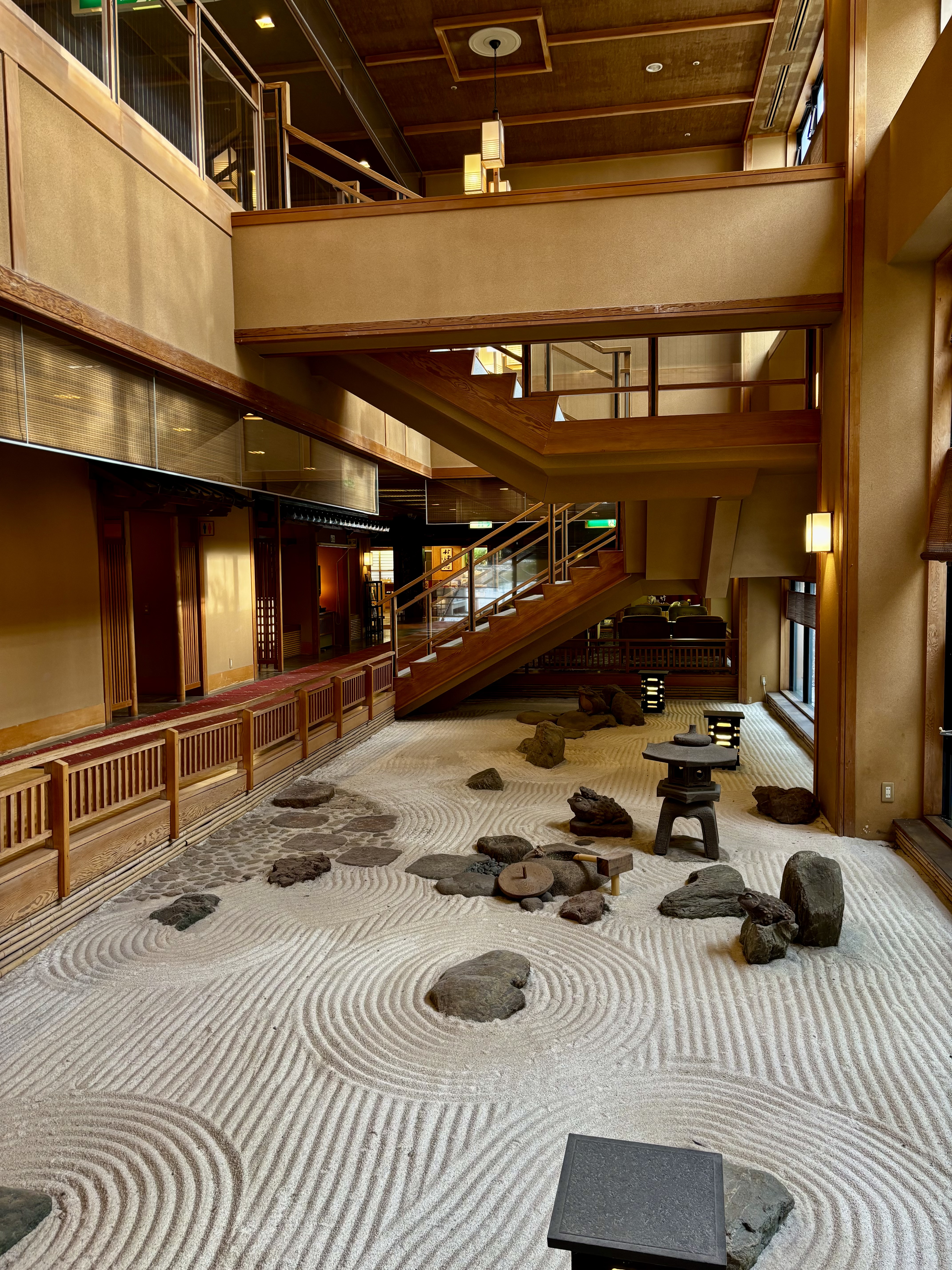
    The Ryoka was the most beautiful stay in the whole 3 month we travelled. It looked very traditional, and as we were walking through the hallways to our room, we noticed a beautiful Karesansui, also known as a zen garden, in the middle of the building. 

    Our room was even more beautiful. There were some western style rooms in the hotel, but of course, we asked for the Japanese style. There were 2 futon beds ready for us in the middle of the room. There was a seating place, where we could enjoy some Japanese tea. The water in the kettle was already waiting for us, hot. The bathroom was great, even though I didn’t use the shower, and in a nearby wardrobe, there were 2 pairs of traditional Japanese room-wear waiting for us.

    Of course, the first thing that we did was to visit the Onsen they had. There were 2 different ones, male and female, that were exchanging regularly, so the guest can enjoy both of them. They both were beautiful, and the Ryokan was relatively empty in the middle of the week, so we could enjoy the onsen mostly by ourselves. What was the best thing about it was that we had the possibility to bath outside in the winter! It was an incredible experience to dive into hot springs water and watch snow falling just next to you. I loved it!

    A part of our stay was also experiencing a traditional Kaiseki dinner, which is a traditional high cuisine that consists of several dishes and multiple servings. I was very much looking forward, but I was also a little bit scared because there were a lot of fish and seafood on the menu. We ate around 18:30, which was surprisingly the latest possible time to have dinner. Honestly, I was not such a big fan, and it was quite hard to eat it at times. Don’t get me wrong, the dishes looked great, and I’m sure they were prepared to perfection, but it was simply not my favourite cup of tea if you know what I mean. Even my partner was struggling, and he is a big fan of seafood and fish. I feel that they were really trying to show the pure and fresh taste of each ingredient, which can be quite challenging if you eat seafood, but also, there were a lot of sashimi and even fish guts, which are not things that are not as common in European cuisine. 

    If you are interested in seeing what was on the menu, you can look here and translate the menu card for yourself using Google Translate.

    Day 70

    The next day, we had a special breakfast too. I have to say I was scared what would be on the menu after dinner, but also our stomachs are not the strongest in the morning. In the end, though, it was better than I thought. I stayed away from the raw fish insides, though. The menu was great, included some sashimi, rice, fermented vegetables, tofu, fish such as anchovies, served with some tea and orange juice. I enjoyed it a lot in the end.

    Of course, we had to experience the onsen again, so right after breakfast, I spent some quality time watching the morning snow fall just next to me, enjoying the hot water.

    * * *

    That morning, we left the Ryokan, entering this crazy snow storm, which was such fun, even though we were freezing and sliding on the road with our heavy backpacks. We were finally ready to travel deeper into the Hokkaido region, ending up in Sapporo.

  • Travelogues of Japan 6# – Kyūshū part 1

    Travelogues of Japan 6# – Kyūshū part 1


    Day by day in Beppu…

    Day 35

    We started our Kyushu adventure in Beppu. This city is well known in Japan as an onsen city, one of the most tattoo-friendly. Of course, after our long and tiring travel, we just had to visit an onsen, and so we took a walk to a nearby one. This onsen, called Umezono Onsen, was a very small and traditional one. 

    Honestly, we had no idea how to behave there, and our first visit felt a little bit awkward. After a few days, though, as I visited the onset more often, I picked up a few etiquette rules. Here is what I would suggest for you:

    1. If you have tattoos, always check if the onsen you are entering is tattoo-friendly. In many onsen in Beppu, this is allowed, but if you are somewhere else, you might check with them directly. Sometimes they are okay with foreigners having tattoos, and the etiquette is addressed for the Japanese only. 
    2. You enter the onsen completely naked. Do not bring any clothes or a swimsuit. If you want, you can take a small towel. For men, you can put the towel around your waist before entering the water and then simply place the towel on your head. For women, you also bring only a small towel, placing it in the front part of the body only. 
    3. Before you enter the common bath, you should wash yourself thoroughly in the onsen area. 
    4. If you have long hair, you are supposed to tie it up and not touch the water with your hair at all. The same good with the towel.
    5. You can stay in the onsen as much as you want. Be aware that the water can be very hot, and be careful to drink well before entering. The time recommended depends on the water temperature, becoming shorter as the temperature rises, and vice versa.

    Day 36

    On this day, we hiked Mount Yufu. This hike is easily accessible by bus, which will take you straight from Beppu bus station to Yufu Tozanchichi bus stop. It was definitely one of the most beautiful and accessible hikes we did in Japan.

    The hike started with a beautiful view of the mountains and nearby hills, featuring finely spread volcanic rocks and trees. Then, slowly transitioned into a thin forest with a rocky trail. As we were reaching the top, the trees were getting smaller and less dense. It was quite a hard hike for me. I am not sure why, but I felt a little bit dizzy most of the way up. Maybe it was a lack of food?

    My advice! Not only are hiking shoes and clothes necessary for hiking. One of the most important items to think of is food and water. Make sure you have a nice, nutritious breakfast, and drink well before the hike as well.

    At the top, there were two main summits; the one on the left was quite steep and dangerous, and there were a lot of passages with chains, basically gentle climbing. We attempted to go there, but I am very much scared of heights, and in the middle of the trail, I just gave up. I left my partner to go check the summit by himself. We headed the way back to the right, aiming for the other top of the mountain. This trail was also very steep, but there were no chains and you could easement get there in about 15-20 minutes. 

    Finally, we reached the top and ate. I was so hungry and exhausted, we had to stop a few times on the way up because I wasn’t feeling so well. However, after we ate, I felt much better, and I was ready for the way down. We decided to take a different trail the way down. The reason for this was simply that we dislike taking the same trail 2 times; I personally find it a little bit boring. And so we continued to the right until we reached the turn. 

    I have to warn you, if you attempt to do the same trail as us, be aware that the way down was very unused, quite slippery, at spots there was a climbing way down on literally vertical spots using ropes half of the way, and after a half, it was hard to find the right trail. The way was leading through a forest, but it was not marked very well, and you couldn’t see the trail under your feet. Don’t get me wrong, I loved it even more than the way up, just prepare yourself to be well aware of the possibility of getting lost, and be mindful of where you go. I would recommend you have some sort of tracking app where you can see the way in front of you as well as where you are. I used Relive and was very much okay with it. 

    We finished our hike successfully, taking a bus back, having a hot shower and headed to try a ramen that was located just 2 2-minute walk from our accommodation, The Noodle Factory Life. This ramen place jumped right to the first place on my ramen list from Japan. I took a spicy ramen the some minced meat, it was amazing! I am pretty sure that the tare was made from miso and black sesame, and the spiciness came from a spicy oil on top. The noodles were amazing, and the flavours were well-balanced too. After that, the day ended fast after dinner since we were exhausted from the hike.

    Day 37

    The next day was very tiring since I experienced another homing hangover. At this point, I really started to doubt my cardio abilities. Anyway, the day was mostly spent sleeping and resting until the evening, when we decided to go out to celebrate Halloween. 

    We went to a nearby bar called Beppu Social Bar. It was very nice because they had a Halloween promotion, 100 yen for one shot until midnight. There we met a lot of great people and enjoyed our time very much. If you think about partying in Beppu, definitely check out this bar. 

    Day 38

    The next day, we decided to visit the number one attraction in Beppu, the hells. These are hot springs that are a result of the volcanic activity of Mt. Tsurumi. These hells earned their name because they can reach up to 100 degrees!

    There are about 7 different zones where you can pay 500 yen to enter each to see these hells. You can also pay a fixed amount that would let you go to see all of them, resulting in a discounted price. 

    I really liked this attention, even if I was a little bit American at the beginning, but in the end, I think it was worth it. The only thing I was missing was some explanations about how these different types of hot springs form. I think if they added this, it would be just great. 

    Day 39

    The next day, we finally decided it was time to hike Mount Tsurumi. The night before, we found a blog post talking about a hiking trail to this volcano, starting at sea level, going through the whole city of Beppu, and reaching the summit of the mountain. The whole route was supposed to take approximately 3h 50m, hiking for 12 km. The plan was to start the hike at around 9 o’clock in the morning, hiking the whole day and coming back using the lift and bus. The hike was called “One shot” and it was something that we were very much looking forward to.

    Warning! Do not attempt to do the same hike without doing prior research and finishing reading the whole day 39.

    The hike started at Matohagama Beach, taking us on an exciting adventure upstream. It all felt like a quest, just having a picture of a map and trying to figure out the way, while looking at beautiful scenarios of water birds living next to the river. At the beginning, the way was very straightforward (mostly because we only had to follow the river), but also a little bit confusing. It felt like the trail was not very well-maintained, and it was not updated. The trail marking was quite straightforward, so we thought that maybe it was a little too late for the hike; they simply don’t maintain it in late autumn and winter.

    We continued our way, slowly passing all the big buildings, the scene before us transforming into a countryside view on the edge of the city. Then, all of a sudden, upon arrival at the edge of the forest, we stood shocked, seeing that the trail in front of us had completely collapsed into a nearby river. There was no way we could pass through there. 

    Of course, this ‘little’ obstacle didn’t stop us. We decided we simply need to find a way around the trial and then just continue the way that was indicated on the map. Thanks god for my trail tracking app, as there are many tourist trails that are normally not seen on Google Maps. The plant was to go on a road for cars, walk for a few minutes and then turn right heading to our original path. 

    We could be more stupid than blindly following a way through the forest to get to this road. As we arrived, we saw a 2-meter-high vertical platform built to hold this road. Guess what we did? Of course, we climbed it. You cannot imagine the face of the people driving their cars as we emerged from the nothingness of the forest… At this point, we were a little bit sceptical, but also amused by our idiocracy of going against all the obviously dangerous obstacles. 

    We finally turned from the road for cars and took a strangely looking road. At the end of it, we reached some sort of god’s forgotten settlement in the middle of the forest, the thing was the path was literally just behind this settlement. We decided it would be best not to pass through there because we thought it was private property and didn’t want to cause any trouble… or end up chopped up in someone’s basement. We then decided it would be best to try to go around yet another obstacle. We chose to follow the river, jumping through it, and after a few minutes of walking, we arrived at what looked like a cascade with a waterfall. We couldn’t see how deep it was because it was surrounded by water, but we could see a bridge that was a part of the trail we needed to take in the distance. So, like idiots, we found some big rocks that we threw in the stream to be able to cross it without getting wet. We then climbed the cascade using a metal ladder attached to the construction of the cascade. We reached the top and realised that we were dealing with at least 10 meter 10-meter-high waterfall. On the other side, there was another leather, though this one was not safely attached to the construction; it was just some old junk that was installed there by someone with ropes. It looked quite dangerous, so we decided not to use it; instead, we climbed down the forest that surrounded this cascade.

    Finally, we reached the damn original trail. At that time, we were still quite enthusiastic because it was quite fun to try to pass through all the obstacles. Soon, though, as we continued the trail, we noticed that this side of the path is really not well-maintained. It was fine because it wasn’t really dangerous, but it just felt weird. We were thinking, are we supposed to be here? The surroundings looked wild; there were stones and trees and beaches all around us, blocking the path, which was hard to see at all.

    After the way finally started to look like a real hiking trail, we noticed this post with a picture of the fallen tree that we had seen earlier in our journey. 

    It means: The Tsurumi-dake hiking trail was destroyed by Typhoon in September 2014!!!!!!!! The road in the Hotta area has collapsed, so you cannot pass through!

    What the actual f***?! The path collapsed in 2014! We were hiking in 2025! That is 11 years ago! And they couldn’t let us know at the beginning of the trail, at the beach!? Why is this information not written there? Why does this trail still exist? Why are there still all the signs and the map? Why didn’t anyone remove it??? We honestly thought that maybe something had happened very recently. But now it all made sense. You cannot imagine our confusion!

    Confused as we were, we continued hiking. We already spent around 2,5 hours on this path, losing a lot of time trying to go around all these obstacles. After this, the path got significantly better; unfortunately, our mood was a little bit disturbed at that point. Our only aim was to just finish what we started. 

    The rest of the way was fine, but around the lift area, it was a bit badly indicated, which just added to our frustration. I don’t understand why, because this was supposed to be a more official and common trail that is still hiked by many people every day. 

    We reached the summit in the next 2 hours from then, totalling with the total time 5h 30, the distance was 15.1 km and the elevation 1534m!

    If you decide to go to this mountain, I would definitely recommend that you do some research first. You can hike from the lift or simply take the lift. The top of the mountain was quite windy and cold, so I would recommend you take some layers. We paid 1200 yen per person for the lift, only the way down. 

    In the end, regardless of all the obstacles, it was a very fun as well as strange hike that we will definitely remember for the rest of our lives.

    Day by day in Bungo-Ono…

    Day 40

    On this day, we arrived at a camping area called Lodge Kiyokawa. This spot is known for its treehouses. There is a possibility of a lot of activities such as renting bikes or e-bikes, saunas, rafting and BBQ. 

    The location is good, especially if you have a car; without it, it might get a little bit tricky to get there. There should be a train going every hour (with occasional holes in the timetable), but then you also need to walk for about 30 minutes to get there. That’s why I would recommend it, especially if you have a car. 

    As we arrived, we realised we should have bought some food, because there were no supermarkets nearby. We decided to rent e-bikes and explore a nearby city, where we bought some groceries for that evening and the next few days. The way felt like a big adventure, and even though the way was quite hilly, it was very enjoyable with the e-bikes. The way back was even more fun because it was getting dark. I feel it was such an adventure for the first day there.

    Day 41

    Originally, we planned to do a hike to Mount Aso on this day; however, this was not possible due to the limited number of connections. Instead, we then decided to spend the day in the camp and book a sauna. There were 2 types of sauna there. One was built in, a beautiful finish sauna, and the other was these built tents that were positioned right next to the river. The idea of it was so nice, in the mountain environment next to the river. We decided to book the built sauna, which was a little bit more expensive, but it was definitely worth it. The prices for guests that were staying at the lodge were 1500 for the tent sauna and 2000 for the built sauna per person for 2 hours. For guests from outside, it was 500 yen more for each type. 

    Before doing the sauna, we went to a restaurant that was located on the other side of the river. It was a very nice concept, only opens for lunch service. You could order some homemade pizza or other dishes, including a curry. The dishes were amazing, and we had a dessert as well. Definitely recommend, even if you just drive around the place.

    Around 4, we had the sauna. Damn, I really needed these 2 hours of relaxation. Usually, we just dipped ourselves into a cold bath that was located next to the sauna, but we also ran to the river to cool down there. It was amazing.

    After trios we had some dinner and joined a bonfire with free possibility to have some marshmallows! What a great day!

    Day 42

    The next day, we wanted a little bit more action, so we rented the e-bikes again and biked to a nearby waterfall, called Harajirino Falls. The bike took around 1 hour and was very pleasant, taking us through huge rice fields. 

    After arriving, we left our bikes next to a shopping place and took a walk around the falls. It was very beautiful. We discovered that it originated from volcanic activity! 

    On the way back, we decided to bike around 2 sale breweries. We didn’t stay long since we couldn’t buy anything because of our long stay, but if you go around by car, I would recommend that you look at some of their products. 

    Day by day in Nabeoka…

    Day 43

    Travel to Nabeoka was very chaotic. I didn’t check the train connections well, so when we arrived at the station, we had to wait for 2 hours until the next train to Oita arrived. Finally, we arrived in Oita and changed for a train to the Miyazaki airport direction, getting off in Nabeoka. 

    We didn’t imagine Nabeoka like this at all. It is a small city that has a rather town-like vibe of a town, which made us question our decisions about this choice. But the main purpose of it was to have a convenient place from which we can visit the Takochiho Gorge.

    Our impression changed right after we visited a restaurant that was recommended to us by a Japanese person. It is called Nao Chan (Chicken Nanban), and it is located close to the Nabeoka train station. They only have about 3 dishes on the menu. For us, it was an obvious choice, taking the classic. 

    My advice. Do not order a tataki style chicken in any restaurant in Japan. This is a cooking technique that cooks meat and fish from the outside, but the inside is still raw! There are cases every year where people die from salmonella eating this type of chicken!

    This dish jumped right to the top 5 of the dishes we had in Japan so far. It was tender, with some sort of fried egg hair on top, served with sweet and sour sauce (nanban sauce), cabbage, miso soup, tofu, rice, and some vegetables. The sauce was perfectly complementing the chicken, and it was soaking into the fried egg on top. I ended up even dipping my rice into the sauce as I didn’t have enough of it. 

    After this, we headed back to the hotel (APA hotel), finished our laundry, and headed to bed. 

    During the night, Nabeoka couldn’t be more as we experienced our first earthquake ever! One of my wishes when travelling to Japan was to experience this, and it came when I would never have expected it. The earthquake itself wasn’t strong at all; in fact, I don’t think we would even feel it if we weren’t lying in bed. I woke up in the middle of the night because I was feeling hot. I was turning around in bed, and then it arrived. It felt as if someone had kicked into a waterbed. It stopped as soon as it started, but it left me feeling very on edge. In other words, I almost shitted myself. I woke up my partner, but he didn’t feel anything at all, because he was deeply asleep. For a while, I thought maybe it wasn’t an earthquake because the bed moved when we turned in it, and I couldn’t see any record of the earthquake on a Japan Meteorological Agency website. But after a few minutes, they updated it, and it was max seismic intensity 3, epicentre in the Hyuganda sea, in Naobeka intensity 2. I knew it! During the night, we experienced another similar earthquake, where we could feel it both, but this time we weren’t sure until the morning, when we checked again. The same spot 2 times during one night! Naobeka, you kept surprising us on this day.

    Day 44

    We were speculating a lot about whether we should visit the Takochiho gorge. We were aware that if we didn’t make a reservation, we wouldn’t be able to take a boat. But in the end, we decided that we would not do that anyway and only take a walk in the area to see it. In the end, it was a great decision in my opinion, because we enjoyed it a lot.

    We took a bus from Nabeoka station. We were so lucky because we came well in advance and noticed a small bus station where they were selling tickets to visitors with foreign passports. This was a great deal, because we paid only 2000 yen per person instead of 1800 each way, which we would pay if we just used shiva or paid cash to the driver. All you needed to do it to take a ticket when you entered, and when you approached the driver, you would only show him the ready-made day pass. 

    We took a map from the tourist information centre and planned to visit a nearby shrine, and then take a walking path through a forest behind it. This was, however, not possible since we noticed at the very beginning of the trail that it was closed. Instead, we made a compromise by halfway following the road and halfway following a walking path. 

    The gorge was beautiful, even though we didn’t go and a boat, and I took a lot of nice pictures there. 

    After the adventure, we decided to go out in the evening. Originally, our plan was to go to an Izakaya, a traditional Japanese bar/food. We tried in total of 3 different ones, but we were rejected from each. They said that they are full, but I have a feeling that they just really don’t want any foreigners there. After all these awkward experiences, we decided to try our first Korean in Japan. 

    I have to say I had no idea about how ignorant I am in this cuisine because I had no idea what the meals on the menu were. Stressed as we were already from all our rejections, we just randomly selected some meals. It was very funny because we obviously didn’t choose things that would fill us up, and the waiter was waiting for more items to order when we were already done with the order. It was very always situation, but in the end we added one more item after the first order, and everything went well. The staff was so nice, though. They were showing us how to eat everything and being very patient with us, regardless of the huge language barrier. Since my partner spoke as much Japanese as they spoke English. In the end, this restaurant was one of our favourites, and it was also a refreshing change from the constant Japanese food. Here is the place if you want to check it out! 

    Day 45

    Our last full day in Nabeoka, we spent in the library situated above the main train station. It is probably the frayed place there is in Nabeoka. The library is new, built in collaboration with Starbucks, so you can enjoy some coffee while spending your time there. The place is quite big and usually full of people. The atmosphere there is really unforgettable, the comfy chairs and beautiful views while you are working on your stuff are just great. I am glad we spent our last day here. 

    * * *

  • Travelogues of Japan #5 – Hiroshima & Yamaguchi

    Travelogues of Japan #5 – Hiroshima & Yamaguchi


    Day by day in Hiroshima…

    Day 27

    The travel to Hiroshima was one of the longest distances we’ve done so far, and that’s why we decided to travel by Shinkansen this time. The way was quite straightforward, but for some reason I felt a little bit nauseous in the train. After arriving in Hiroshima, we took a tram that led us to the edge of the city. 

    We were staying in a neighbor’s hotel near Rakurakuen station. We planned to stay there because our main objective was to visit the Itsukushima island.

    The place itself was great, located in what seemed to be the middle of nowhere; it was calm and quiet. As we arrived, we received a small gift from the host, a traditional Hiroshima confectionery called Mojimi Manju. This is a small, cake-like sweet that is filled with different types of filling, such as custard, chestnut cream, or chocolate cream. 

    We were quite tired from the travel that we decided to rest that evening, and so we watched the 3rd season of Alice in Bortherland. We ate that season in one sitting, or did it eat us? 

    Day 28

    The next day, we visited the Hiroshima atomic bomb museum. Even though there were many people, we were able to enjoy ourselves. I would recommend this to everyone. I cannot describe this experience other than heartbreaking. It was a very intense experience that reminded us about the bad things happening in the world. There was something so emotional about walking through those halls, surrounded by the relics of devastation and the echoes of unimaginable suffering, knowing we were mere tourists, protected by time and the safety of the present, yet unable to escape the guilt and discomfort that comes from witnessing so much pain distilled into glass cases and somber displays. It felt as if we were intruding on the raw wounds of history, vulnerable to a kind of dark fascination. Still, it is definitely a must-do.

    After the museum, it was lunchtime, and one of my must-dos of the visit to the city was actually to try the Okonomiyaki from Hiroshima.

    We went to what was an Okonomiyaki paradise, The Okonomimura, which was located only a few minutes ‘ walk from the museum. There were plenty of Okonomiyaki restaurants, but we decided to eat in one that was located on the very first floor, being the first restaurant you can see as you enter the building stairs. It was a very small restaurant where the dish was prepared in front of you. Very fast food style and super delicious. The portions were great; I wasn’t even able to finish mine, as big as it was. If you are not interested in this one, there are plenty of other okonomiyaki restaurants in this building; there are so many choices, allowing you to do your own research about which one suits you best.

    Day 29

    Finally, the day when we hiked on Itsukushima Island came by. We bought some food for our travel and took the same line we did for going to the hotel, stopping at Miyajimaguchi station, from which we took a boat to the island itself. It was very easy to use the Suica travel card. The ferry runs quite often since the place is quite touristy. I would say everyone who visits Hiroshima visits this island. We walked along the beach to the famous Itsukushima Jinja. We didn’t go inside the temple because there were quite a lot of people, including many school groups that were visiting it. If you would like to, I would recommend you come early in the morning as it is much more acceptable at early hours. 

    Instead, we took a trail that started behind the Momijidami Park, called the Misen Mountain Trail. If you want to do the hike instead of a ropeway as well, just follow the signs to the ropeway and then change to the Misen Mountain Trail – Momijidani Course as we did. Here is a link for a post where I retrieved one of the maps.

    The hike itself was very beautiful, but we were aware that there was a poisonous snake present on that mountain. The whole process took about 4h 30m (breaks included), with an elevation of approximately 723m.

    At the top of the mountain, there was the beautiful Shishiiwa observatory. We had our lunch, and after a few minutes, we decided to hike to the second-highest peak there, Mount Komagabayashi. Think this peak was even more pleasant because there were beautiful rocks, big rocks you could sit on, and almost no tourists. 

    The way down, we went through the other side, taking a round route, as always, arriving at the Omoto park, passing the Miyajima Aquarium, and getting back to the beginning of the trail. I would definitely recommend this hike to anyone visiting the island!

    Day 30-31

    Every traveler must rest from time to time, and after one month of traveling, we decided we wanted to take it slowly. Our main objective was to rest and to work on our projects. I had plenty of pictures to edit and plenty of work with writing the blog, and so that was the main activity of these two days.

    Other than that, we visited a nearby mall where we had dinner each night. The first time we chose to have some Katsu Don and Oyaku Don. The next day, we went for ramen. Both of these were very budget-friendly and casual Japanese dining, which didn’t take away from their quality.

    Day by day in Yamaguchi

    Day 32

    Day 32 was finally a little more active. We left Hiroshima, taking the San-yo line instead of the Shinkansen, changing at Iwakuni station, resulting in almost 3000 yen difference. I find it crazy how much you can save when you take the alternative connections in Japan.

    The city of Yamaguchi, meaning the entrance of a mountain, was a beautiful small city surrounded by beautiful mountains. In the city itself, there was not much to do, but there was a possibility for a nice day trip.

    We stayed in Hotel Comfort in Yamaguchi, which was perfectly located just next to the station and had quite a nice free-of-charge breakfast.

    In the evening, we took a walk to a Katsu restaurant called とんかつ専門店 いちただ. A lively restaurant with very nice and friendly staff. The Katsu left us full and prepared us for another full day of discoveries.

    Day 33

    The following day, we went for a hike. We took a bus from Shin-Yamaguchi Eki (station) to 秋芳洞 (Akiyoshido cave). There is a limited number of buses per day; however, if you plan this properly, there should be no problem. The first bus leaves at around 7:35, and then after 10am, and on the way back, the last bus is around 17pm, keeping in mind the schedule might change throughout the week. Just plan your trip, and it should all be fine.

    Our plan was to do a hike in the Akiyoshidai Quasi-National Park, where you can see beautiful scenes of hills and rocks that are left from the magma activities. The whole plateau is falling down because of water and soil interacting, resulting in beautiful views and scenes. 

    As we arrived at the bus stop near Akiyoshido cave, we followed a tourist map we found online, from which the following picture was retrieved. We combined in total 3 different trials, resulting in a hike of approximately 3 hours. We planned to hike more of the dark blue trail, but the way was not marked very well, and we didn’t notice there was more to it, so we ended up trekking a shorter trail than anticipated. Here you can find the way we took. I tried to mark it with a black line, and also marked where the cave started. Of course, if you do this trail, you can just customise it to your preference. Furthermore, at the end of the trail, just a few minutes before reaching the cave, it might be weird for you because the trail is not marked on this map, but just go straight and you will be fine.

    The hike itself was more of a trekking; it was not heavy at all, and the length was great. We started the journey a little bit weird. If this way confuses you, just follow Google Maps to this parking lot. The way is a little steep, and it is next to a road, but as soon as you get there (around 30 minutes), you should be fine. Upon your arrival, look for a small path that goes under a bridge, choosing the path on your right, crossing the road, and you are on the way. Hopefully, the map will help you too.

    As we reached the end of our trial, we ended up at the end of the cave (the red mark on the map) and took a tour that cost around 1600 yen per person to the beginning of the cave, where we took a bus from, back to Shin-Yamaguchi station.

    I would definitely recommend visiting this cave. It is one of the biggest caves in Japan, and it is beautiful. Honestly, I wasn’t expecting the tour to turn out to be so interesting. 

    Day 34

    On the last day of Yamaguchi, we decided to take a walk on the beach. We bought some snacks from a local grocery store and headed to the station. We went to a beach called 美濃が浜, and the way there was a little bit tricky since there were not a lot of bus connections. There is maybe one bus that goes there per day, and one in the afternoon. So took this bus + walking for about 20-30 minutes.

    As we arrived, we were a little disappointed about how the beach was, but soon we made ourselves comfortable, sitting in one of the Benton plates, eating our treats, and enjoying the occasional sun shining on us while engaging in interesting conversations. The way back was quite a hustle, because we had to walk to a further bus stop than before, 長浜入口.

    In the evening, we decided to try a local specialty, Karawa Soba. This is a unique dish where matcha soba noodles are served on a hot tile called Kawara with toppings like beef, egg, and vegetables, which are then dipped in a savory sauce, usually seasoned with lemon. The place we went to was very close to the station, and it was a hotel as well. You can find it by this name: ダイニング&鉄板焼 さくら. The atmosphere of the place was great, and the staff was very nice. The noodles were supposed to first be eaten plain, to try their true taste, then dipped in sauce with lemon, and in the end, as they gradually crusted on the hot plate, try them in that manner.

    * * *

    And our little adventure in the Chūgoku region had come to an end. The next day, we were excited to start our new chapter, travelling through the Kyūshū region, starting our journey in the king of onsen, Beppu.

  • Travelogues of Japan #4 – The oldest town, Kyoto

    Travelogues of Japan #4 – The oldest town, Kyoto


    Day by day…

    Day 21

    Travel to Kyoto was quite unusual, since we took a bus instead of a Shinkansen, guess why… of course, the cost was much cheaper. We booked the tickets online, going from Nagoya station to Kyoto station, Chuoguchi, I believe it was through the website called WILLER.

    The travel was not the most pleasant one, since it took around 2h 15m, and right after our arrival, we saw how touristy Kyoto is. We took a bus to our hostel, which is one of the main lines that goes through the most touristy places, I think it was number 206 or 207. We loaded ourselves on the bus… literally… with the heavy backpacks, not knowing what was ahead of us at that time, trying to be the most out of the way possible, heading to the very back of the bus. After a few stops, at least 50 people got into the tiny 15-seat bus. OMG! We had to start our journey to the front of the bus well in advance before we arrived at our stop (since you pay the driver). We had to squeeze through all these people to the very front and get out. I wish to say I never had to get on this bus again, but as it was one of the main lines, it was not really possible to do without using it again.

    We were so extremely exhausted from the whole experience of getting from Nayoga to Kyoto. We arrived at the hostel – Gion Ryokan Q-beh, left our stuff behind, and went to a nearby shop to buy some lunch while waiting for check-in. After taking a shower and resting, we only went out to have some dinner. We went to a ramen place nearby, where it was okay but not worth mentioning the name but here is a picture.

    The hostel itself was very pleasant and we enjoyed our stay a lot. It had really great common areas, where we spent a lot of time at the end of our Kyoto experience, working on our projects. The rates were quite expensive, around 34 per night per person, which is one of the highest rates we spent on accommodation in Japan overall, but I guess in Kyoto, it is so over-touristy that you just have to accept that it is simply the price you will pay if you want something somewhat decent. 

    In the evening we only took a little walk to the nearby Yasaka Shrine, to took in the vibes of Kyoto.

    Day 22

    The next day, we woke up a little bit later and were quite excited to visit the famous bamboo forest in Kyoto. Which was, in my opinion. Not worth it at all. We took maybe the longest overfilled bus to get there, and it took around 1 hour from our hostel. And damn the number of people there, it was a tragedy. We were there around 10-11ish, and it was already so full. The bamboo forest was not worth it at all, at least not with all the people just F***G around. It really didn’t make my day, and made me really nervous. Everyone there was just there trying to take a stupid picture that they can showcase on their social media with some stupid description about how life is amazing, and this bamboo forest is so magical… but in the end, it just sucked. That’s the reality you will never see in any picture on social media. Btw, on our way back, there were even more people!

    The only thing that saved this awful morning was my partner, since he found a nice hike that was, btw, much better than the tiny and lame bamboo forest full of people. We ended up hiking, and it was very nice and almost completely human-free. If you are interested, here is the trail that we took. Definitely Vanesa approved, just look at the beauties we saw!

    The trail was not so straightforward. For example, there was a fence?!?! After translating what was written there, it was clear we could pass, but it got quite confusing at that time. If you want more details about how we went, you can follow our exact trail over here.

    In the evening we went for a tempura in a restaurant called 京都海老天丼 徳. The food was great, but a little bit too expensive for what it was, in my opinion.

    Day 23

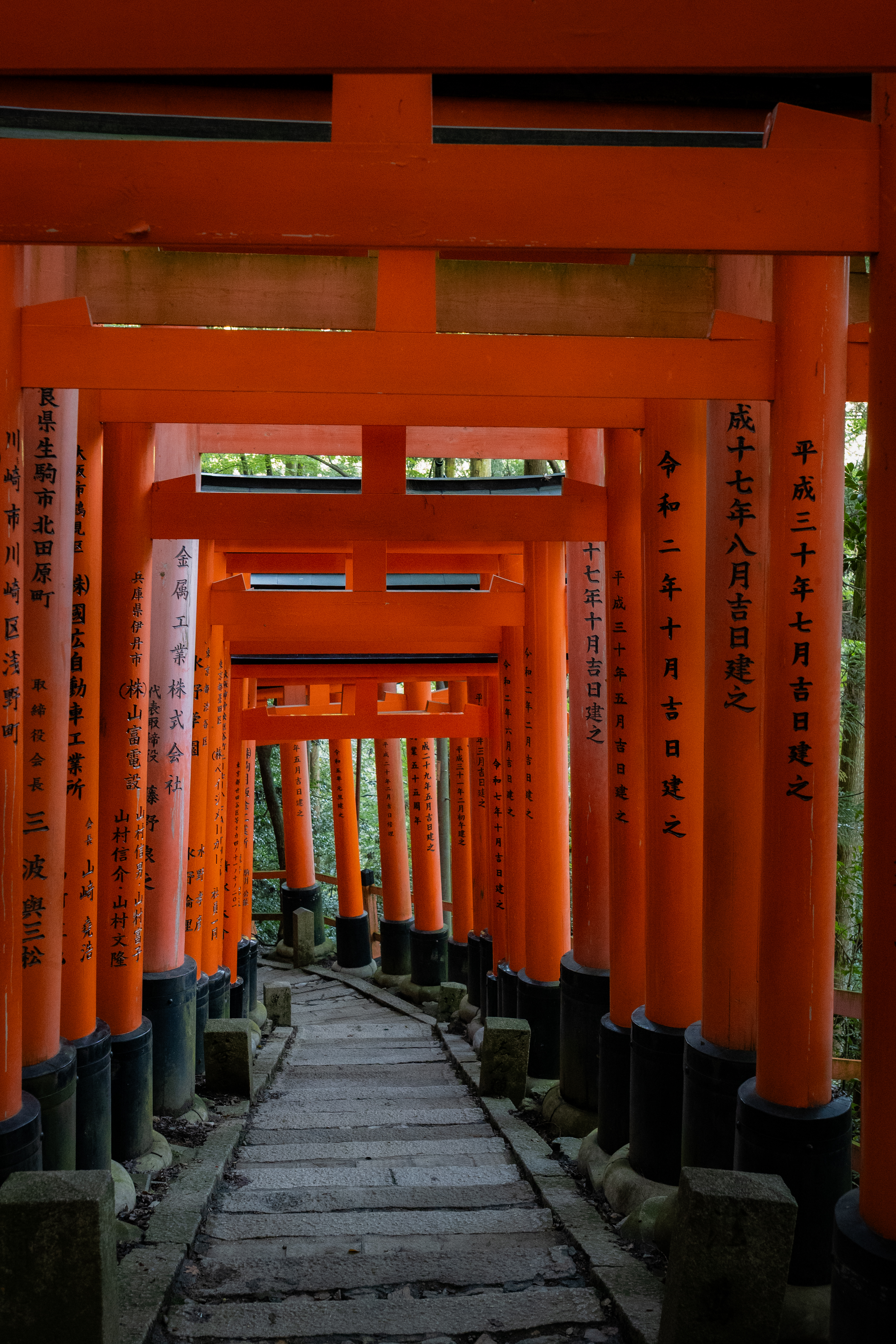
    For me, day 23 was the best day in Kyoto. We woke up super early, around 5:30, to get to the famous Fushimi Inari Taisha temple 伏見稲荷大社. 

    We decided that based on our experience from the day before, this place would be crazy overcrowded, and so, naturally, we made a decision to wake up crazy early. We started our day at around 5am and took the first public transport that we could catch, heading right to the temple. We arrived there just after 6 o’clock, and there were already some crazy people like us. We took a hike to the top, passing these beautiful, bright red shrines, taking pictures, and enjoying the views. In about 1-2 hours, we reached the top (picture time included). On our way down, we started to notice that there were many more people, and it started to be a little bit frustrating; however, happy as we were already seeing all the beautiful sights, we didn’t mind so much. 

    After we arrived at the very beginning of the temple, at around 9, the number of people had drastically increased. I cannot imagine what the place would look like around 11 or 13 o’clock.

    After this, we decided it was simply too early and not enough to stop our touristic activities, and so, we did what I would say was the hardest hike we did in Japan so far. We were hiking to Mount Atago. If you are interested in the hike, here is the link to the Komoot trail, and here is what we actually did on the Relive app. Please don’t get confused by the long way through the city you can see on the map. We were actually going on a bus. We took it from the Nonomiya bus stop in Kyoto, located not so far from the bamboo forest, and got off at Kiyotaki bus stop, using bus number 92, where we actually started the hike.

    If you are looking for a nice, challenging hike, this is definitely the one for you. We did an elevation of approximately 1200m, and it was quite steep! Basically, the whole way was uphill. The top was quite touristy, but mostly populated by school trips or local tourists that were probably taking a different way because we didn’t see any of them on our way up. The very top was interesting, the temple located there was almost mysterious, and we kept wondering how people managed to bring food and other supplies to the top of the mountain in the past.

    The way back, we took a different trail, which started just before the stairs that led to the temple, taking the trail on the right. I would recommend you to be careful with what trail you choose and follow the map thoughtfully, otherwise you might get lost easily. After finding the right path, it was a pretty straightforward thought. On our way down, we met only one person. Which was good and worrisome at the same time. The way just fell a little bit abandoned. What made it the scariest bit was when, at some point deeply in the mountain, we reached a little settlement guarded by this statue.

    It felt like we entered a place stuck in time, the old buildings, almost falling apart, but it was obvious that someone lived there, as we saw how a new set of clothes was hanging out in the sun for them to dry. The signs of Keep Out were everywhere. The most uncomfortable thing was that even though it was obviously inhabited, there was no one to be seen. The quietness of the place was simply unsettling, and I had a feeling that we were not welcome here at all. We couldn’t do anything else then pass through there because it was simply the only way to go. After this, nothing exceptional happened. We simply finished the trail, forgetting about this mysterious place. 

    Day 24

    The next day we woke up we woke up with the biggest hiking hangover ever. I don’t know for what reason I was so tired; I feel the whole day was just about my groggy existence. 

    Even though we were tired, we had a big quest in front of us. Shopping. We were planning to take some souvenirs with us home to bring to our friends and families. Our initial plan was to do a big shopping in our last destination, which was Tokyo, buy a big luggage and just stuff it with all the souvenirs we would buy. But in Kyoto, we had a better idea.

    We decided to shop for 90% of the items in Kyoto, and then send a parcel to my family in Slovakia. The reason for this was that if we sent it by boat, the cost should be relatively cheap (and possibly cheaper and more stress-free than taking extra luggage), and anyway, we would not come before the middle of December, which is about 2 months from this day. So we made our shopping list and went hunting for souvenirs…

    Day 25

    The next day, we still had some items on our shopping list, and so after a nice breakfast, we headed for the city again. Among the places we were shopping in these past 2 days were, for example, the Nintendo store in Kyoto, the Hands, where we could buy some fans and matcha sets for reasonable prices. We also visited some smaller souvenir stores along the Kyoto-Kawaramachi, and also bought an old tea set in an antique store, located near Yasaka Shrine. We also ended up wandering in a quite nice street called Nishikikoji-Dori, where I bought some nice tea blends. 

    In the evening we went eat to a place called . I had this great katsuobushi udon noodles and my partner had a tofu udon. I would definitely recommend the place, but it felt rather touristy than something a Japanese would go for.

    Day 26

    On our last day in Kyoto, we were sending the package. We went to a Japanese post office, specifically the Kyōto Kiyomizu Post Office 京都清水郵便局. They were so lively and helpful there, the younger worker even spoke a pretty good English. 

    First, we went there and bought a box, then headed to our hostel to pack everything. We came back to the post office ready to send it, but realised we had to make a list of all the items we are sending! So we made such a mess in there, all the workers looking at us as we were unpacking it, the newspaper flew all around the office, we made such a mess, I was ashamed of us, but what can you do if you don’t remember what you put in? 

    Finally, we managed to put everything back, and we were ready to send it. We paid approximately 40 euros, if my memory is correct, which was from Kyoto to Slovakia, sending it by ground. This was much cheaper than flying by plane, but at the same time, we are not quite sure when it will arrive. We hope before Christmas, which is in two months. As I am writing this, the parcel is somewhere in the middle of the ocean. If you are interested in the outcome of this, please let me know in the comments, where I can also answer you! 

    For lunch, we finally had some good stuff. In general, in Kyoto, everything was overpriced and, in my opinion, not worth the money we paid for it, but this place was great! It was called Tonkatsu Buta-Gorilla – Shinkyogoku Rokkaku. They had the best katsu there, including katsu curry that was served with some miso soup and cabbage. The best thing about this place was that you could get a free refill of cabbage, miso soup, and rice! Basically all you can eat! It was very much worth it, and I was so happy that we finally had something nice in Kyoto. 

    * * *

    The evening of that day was very calm, as we were preparing for our next destinations, Hiroshima and Yamaguchi!

  • Travelogues of Japan #3 – Osaka and Nagoya

    Travelogues of Japan #3 – Osaka and Nagoya


    Day by day in Osaka…

    Day 13

    On this day, we traveled to Osaka. It was a very straightforward trip. We chose to take a limited express train instead of a high-speed one, saving around 2500 yen by doing so. The trip took just an hour longer, but saved us 2500 yen; in my eyes, that is more than worth it! To travel this way, you can take a JR Limited Express train from Matsumoto station to Kintetsu-Nagoya station and change to a Kintetsu Limited Express. We got off at the Ōsaka-Uehommachi station because of better connection to our next hostel, but the train continued to the Osaka-Namba Station (the main station).

    The first sight of Osaka was nothing like the Japan we had experienced so far. The vibe was so wild! People were rushing from all directions, there were signalisations missing on the streets, and I am pretty sure bikers were doing some kind of extreme sport instead of commuting, performing some sort of slalom in front of people and cars whenever they pleased. It was much more disorganised compared to Tokyo. After already spending 2 weeks in Japan, I was adapting to the organised existence of Japanese people, so you can imagine my confusion when an old Japanese lady almost pushed me on the side, skipping the line while boarding a metro. Osaka is crazy!

    We arrived at Grand Hostel LDK Osaka. This hostel was even better than the one in Nagano. It was very clean, and the showers were amazing. The hostel was spacious, a refreshing change from the cozy spots we’d stayed in before. The safety was great, we had a very nice small locker located in our bed. The staff was very professional and friendly. The common area was great too, furnished with very comfortable pieces of furniture, with a possibility to book a breakfast for 550 yen (a little expensive, but we had it one time and it was great).

    We were so hyped from the whole vibe of the city that we had to go explore it right after we checked in and organised our stuff. Of course, we went to the most touristic area right away. The street was called Doutonbori, and it is located next to a river. There are so many restaurants, shops, street food, and tourists. The lights flickered above us, featuring crazy attractions, street vendors called out in rapid Osaka-ben, and the scent of sizzling takoyaki filled the air. Doutonbori pulsed with energy; it simply was so dynamic and alive! Maybe a little bit too much? The whole area surrounding this street was like this, and even though it is very touristy, I would recommend you visit it. But please don’t eat there!

    We were very excited to try some local dishes from Osaka, since it is called the kitchen of Japan. For the first night, we decided to go for Okonomiyaki. This is a dish made with a dough similar to a pancake, where some salty seasoning and cabbage are added. The batter is then fried in a pan resembling a thick American-style pancake. The result is both flavourful and soft. The dish is normally served with some Okonomi sauce, mayo, and katsuobushi.

    On the street I mentioned earlier, there were many Okonomiyaki places, but damn it was a scam! All the restaurants around were crazy overpriced. For example, we stopped by a place called Chibo Okonomiyaki, where the price was double what it normally is! After some research and endless walking around, we finally found our Okonomiyaki place. It was called Okonomiyaki Okaru. It seemed to be a family business, with a very straightforward menu. We ordered some beer, akashiyaki, and okinomiyaki. Akashiyaki is a dish similar to takoyaki. They both have a piece of octopus in the middle, but instead, akashiyaki is made of eggs only, served with a dipping broth. The main course was great, and it was prepared in front of us. They made a great show in front of their customers. I have to say that I really enjoyed spending time in this restaurant. The staff were lovely and the dishes were great. As we left Okonomiyaki Okaru, stuffed and happy, I wondered what other culinary surprises Osaka had in store for us.

    Day 14

    The next day, we went to Nara. There is a straight train that goes from Osaka to Nara very often. If you didn’t know Nara, I will explain what it is for you with one word: Deer.

    I knew that in Nara there were deer, but I had no idea how many, and how close the interaction with them is. Right from our arrival, just a few minutes walk from the station, we were literally surrounded by them.

    To be completely honest with you, the place was great, but mostly for taking pictures only. Of course, you could take a nice walk there, and you could also buy some biscuits for the deer and feed them. There were also a lot of temples and shrines (unfortunately, I haven’t seen them from inside because I refused to pay for an entrance to a temple with 10,000 people when I had another 10,000 temples just sitting around Japan for free), and it was all beautiful. But there were a little too many people. I don’t know why, but at the end of the day, the deer seemed more like dogs to me than wild animals. They were so used to humans that they acted almost tame, which took away from their natural wildness. There were basically domesticated there, which makes me sad. I am not sure to what extent they were able to live by themselves and find their own food, but it seemed to me that not. I was getting kinda angry seeing all the people acting with the deer in such disrespect, and no, by that I don’t mean that they were mean to the animals, but why do you just have to walk around and feed them and pet them, and I don’t respect their personal space? I simply felt the deer lost the beauty of their wildness. As a result, the deer became a little bit annoying, like the humans interacting with them, poking into you just so you can feed them, and being way too close and fearless.

    Anyways, don’t get me wrong, the place was nice, if you like animals, then why not, go ahead and visit and take some nice pictures like I did. Some of the interactions with the deer were truly magical, for example, seeing a newborn deer. Or getting startled by another one sniffing my neck.

    Furthermore, another thing was also looking forward to was a local mochi shop, where they make it and directly sell it to you. This way you have the possibility to enjoy a freshly cooked hot mochi. The shop is located on a street behind the station and is quite well-known, you can tell by the amount of tourists. Regardless the tourists it was the best mochi I have ever had.

    After coming back to Osaka and resting for a while, we finally had our first sushi in Japan, at a place called Sushi Bar Tsukinone Uehommachi, located near Uehommachi station. It was a place on the more expensive side, but the sushi was very good. I enjoyed it with a glass of Saika Nigori Cloudy Umeshu. Oh my! The Umeshu was out of this world. Very well-balanced sweetness and acidity of the plum, making it irresistible. The sushi itself was very much comparable to our favourite sushi place in Europe, called Yamayu Santatsu in Brussels. The biggest difference was the price! Quality-wise, it was very similar, but in Europe we would get this fine-quality sushi for about 35 euros per person, for only 7-8 pieces of sushi and nothing more, while in this restaurant we had 2 plates of nigiri (around 10 pieces each), an extra expensive piece of eel sushi, 10 pieces maki, and 2 drinks for 52 euros!

    Day 15

    On day 15th, the Osaka Expo day has arrived. One sentence to describe this event: It was the worst experience in Japan. Spoiler alert: This event was not worth the money that we spent on it.

    We had a ticket for 9:00, arriving at 8:45, and we only got in after 10. Can you imagine the number of people? We didn’t even have time to look around as we were rushing to the first pavilion on our list, Germany. We waited for about 45 minutes to get in. Okay, we were expecting that; however, I felt we were just pushed by all the people and didn’t have time to enjoy the pavilion too much. After that, and after having a very overpriced, disgusting coffee, we rushed to Poland, spending yet another 45 minutes (not counting the time to push ourselves through the mass of people to get there), just so we could be rushed and pushed inside of that pavilion too. Horrible. At that point, it was between 11-12 o’clock and the number of people started to be so disturbing that we couldn’t take it anymore. After another attempt to visit the Slovak pavilion and being disappointed by queuing for 30 minutes to see a lame video for 5 seconds, we had had enough. We decided to leave this event prematurely and swear off ever doing anything like this again. Never, ever, will we do some similar type of event, that’s for sure. Total waste of time, money, and energy. Why would they sell so many tickets? Don’t they have any sense of organization or crowd control?

    Honestly, my plan was to write about every pavilion that we visited, but I really don’t think it deserves so much of my effort. And so, no more pictures and no more comments will be wasted on this topic.

    Day 16

    I don’t know why, but that day I felt as if Osaka was some kind of slippery slope. From the first day to the last, the experience was just gradually going downhill.

    The last day in Osaka was quite stressful because we had a mission. Since we are backpacking in Japan, our clothing supplies are very limited. The next day, we were supposed to have dinner with some old colleagues of my partner, so of course, we wanted to look presentable rather than like some hippie backpackers. I told myself I needed to wear something other than oversized harem pants, and so we went shopping. I just love how some Japanese people dress. In my opinion, it’s super cute, but oh, the clothes in the shops we visited were either nice and super expensive or looked like grandma’s clothes. You can imagine our day. Haha.

    Though in the end, we decided we wanted to “party” a little bit in Osaka. And so we went for some food. On the edge of the block where our hotel was located, there was a great takoyaki place called Amafuku. I can’t imagine a better way to recover from the stressful shopping. We had some Kirin beer, octopus, Kobe beef stomach, and, of course, the takoyaki. The restaurant had a brilliant way of serving them, guiding us through different ways to enjoy takoyaki. You get plain takoyaki, with the option to choose from 6, 8, 10, or 12 pieces. The price of one piece was 90 yen. They were brought to us plain, with instructions on how to try them, and that’s when things got really interesting:

    1. First, they suggested trying them plain – no seasoning, no sauce! Biting into the hot takoyaki, I was surprised by the burst of flavourful juices inside. I’d had takoyaki many times in Europe, but never like this. The filling was so rich and perfectly cooked, melting on my tongue.

    2. Next, we tried adding salt and sesame oil. This was an explosion of flavour! The salt enhanced the natural taste of the octopus and dough, while the sesame oil added a nutty aroma. This became my favourite way to eat takoyaki!

    3. Then, we went wild with soy sauce, mayo, katsuobushi, and chilli powder. The combination was bold and satisfying: the umami of the soy sauce, the creaminess of the mayo, the smokiness of the bonito flakes, and the kick of chilli created a party in my mouth. My second favourite!

    4. We scaled it back with salt, mayo, and bonito flakes. While still delicious, the mayo dominated the flavors a bit too much for my liking. It was good, but I missed the complexity of the previous combinations.

    5. Finally, we tried the classic: takoyaki sauce and mayo. This is a timeless combo for a reason! The sweet and tangy sauce paired perfectly with the creamy mayo, and the bonito flakes added that extra layer of depth. A solid choice, though I still preferred the salt and sesame oil version.

    After the amazing dinner and our tipsy mood, the night still felt young, so we decided to visit a beer bar called Beer Bak Stop. We had many interesting beers (special brews), and enjoyed a great conversation with some Europeans living in Japan.

    Day by day in Nagoya…

    Day 17

    The next day, we packed early in the morning and headed to Nagoya. The main purpose of this visit was to meet up with some old Japanese colleagues. We were informed in advance that we would go to a 飲み会 [nomikai], basically, a night of drinking and socializing, and that we’d visit a total of two restaurants.

    The journey was very pleasant since we took one of the coolest trains I’ve seen so far (in my opinion, even better than the Shinkansen). The seats were extremely comfortable, each with a small footstool attached where you could rest your feet, shoes off, of course. The seats were adjustable, almost reclining to a lying position without disturbing other passengers. What surprised me the most was that you could rotate the entire “double-seat” to face the window or turn it 90 degrees to create a cozy four-seater arrangement. Best of all, the price was cheaper than the Shinkansen!

    We stayed at the Toyoko Inn hotel, arriving just in time to check in, and had a two-hour rest before meeting up with our Japanese friends. Unfortunately, we didn’t realise we’d booked a smoking room, so the entire stay was a bit unpleasant, since the smell of smoke was deeply ingrained in everything. How unfortunate…

    The first restaurant we went to, Hendon, was about a 20-minute walk from the hotel. It was a BBQ-style place where we were served an aperitif of ingredients like mushrooms, a soy-bean-based bread, and cod fish roe wrapped in shiso leaf. We could grill these on a small BBQ at the center of the table while waiting for the main courses. The food came in the style of small sharing dishes: potatoes boiled in soy sauce, octopus-shaped sausages, sashimi with tahini sauce, menma, beef sukiyaki with raw egg, deep-fried arugula, and even fish fin. I’m not sure how expensive the restaurant was since we were kindly treated despite our protests, but I’d guess it was on the pricier side.

    After a few hours of great conversation and amazing food, it was time to move on to the second restaurant! This place, Mitsukura Sakai Main Store, was a sake bar, and wow, it was incredible. We had 90 minutes of unlimited drinks and a spread of food, including sashimi, maki, tempura, and a fish intestine dish (I think it was called shiokara). There were three different soy sauces to pair with it. The sashimi was tuna, and I can honestly say I’ve never tasted better tuna in my life. I tried four different sakes, each with its own complex, gently sweet notes. This was my first time trying sake in Japan, and I was amazed by how nuanced the flavors were—some say they’re even more complex than red wine. It was my first chance to compare multiple sake brands side by side, and the experience was eye-opening.

    We had a fantastic time with our old friends and were treated like honoured guests; we even received a small gift as a parting token! 😊

    Day 18

    The next day, we were quite hungover, so you can imagine we spent the beginning of our day in bed. We had a free breakfast, which is included by default in every Toyoko Inn hotel. It still astonishes me how different breakfast in Japan is compared to Europe. Can you imagine starting your day with rice or noodles?

    In the afternoon, we met with another ex-colleague of my partner and spent time in a yakitori restaurant located inside Nagoya Station. The restaurant was cozy, and the food was good. That said, I wasn’t very fond of the different chicken intestines on offer, but I’m still glad we tried them.

    We also received another gift, which left me feeling unsure about Japanese etiquette. I couldn’t help but wonder if we were supposed to bring a gift as well. I knew gift-giving was an important part of Japanese culture, but I wasn’t sure how to navigate it. I thought I was supposed to open the gift right away, but I couldn’t have been more wrong. After saying our goodbyes, I did some research on the topic, which only made me feel more awkward; I’d completely missed the mark on this cultural custom.

    To save you from making the same mistakes, here are some tips on Japanese gift-giving etiquette:

    1. Gift-giving is a significant part of Japanese culture. You aren’t expected to bring a gift, especially during a first meeting. You also don’t need to reciprocate immediately if someone gives you a gift, but it’s thoughtful to return the gesture in the future.

    2. If you do give a gift, avoid anything too expensive, as it might make the recipient uncomfortable. The gift should be neatly wrapped and representative, such as a piece of your culture, snacks, or a nice bottle of alcohol.

    3. When receiving a gift, accept it with both hands, express gratitude with a bow, and say “ありがとうございます” [arigatou gozaimasu]. You can also say “すみません” [sumimasen] to acknowledge the trouble they’ve gone through for you.

    4. Never open the gift in front of the giver, unless they insist.

    I hope this crash course in Japanese gift-giving etiquette helps you avoid the cringe I experienced!

    In the afternoon, we visited Nagoya Castle. We couldn’t go inside the castle itself, but we had the opportunity to visit a sort of royal house. It was a fun experience, especially since we had to remove our shoes inside. The house was huge, and there were many beautiful paintings on its walls.

    Day 19

    Another day, and another encounter with the Japanese. This time, we went to a BBQ place located about an hour’s drive south of Nagoya, called Uotaro.

    It was a lovely spot situated near the sea, where you can reserve a space for BBQ. The place consists of two parts: one for walk-ins and one for reservations. In the walk-in area, there’s a slight chance you won’t find a spot, or that rain might ruin the BBQ experience. We were in the reserved section, which included a small table with a BBQ grill, trays, cooking equipment, and seasonings like soy sauce, salt, and pepper. You could either bring your own food or buy it from the on-site shop. They offered a variety of seafood, fish, meat, and vegetables. What made the experience even more special was that we were the only foreigners there, giving it an authentic local feel. I think we paid around 9,000 yen for the rental and about 20,000 yen for food for three people. Quite pricey, but definitely worth it.

    We had a fantastic time, leaving completely stuffed, and, you guessed it, received another gift! 😂 This time, it was a fine bottle of whiskey and an Umeshu blend. Thanks to my newfound knowledge of gift-receiving etiquette, the experience was much smoother. Afterward, we took a little walk, spent some time at a bowling alley in Nagoya (where we discovered just how bad we are at bowling), and then headed home.

    Day 20

    After three days of non-stop socialising, we were completely exhausted. So, we decided to spend the next day recharging, sipping matcha in a cozy café, editing photos, and writing this blog. If you’re looking for a peaceful day in Nagoya, I’d highly recommend visiting the serene café at Lamp Light Book Hotel.

    * * *

    That day, our time in Nagoya came to an end, and we were excited to begin our journey to Kyoto, known as the oldest city in Japan.

  • Travelogues of Japan #2 – Hikers’ paradise

    Travelogues of Japan #2 – Hikers’ paradise


    Day by day…

    Day 6

    On day 6, we traveled to Nagano. It was our first time using a Shinkansen line. The train glided so smoothly that it almost felt like flying, and the views of the countryside were stunning. For those who don’t know, this is the fastest, most efficient, as well as most expensive line you can take in Japan. We paid 15,200 yen for 2 people, making approximately 85 euros at the time. It is good to know that you cannot use the Suica travel card for this journey. If you know what you are doing, it is very simple to buy tickets. You can simply purchase the ticket at one of the ticket counters that are specifically selling it for the Shinkansen line.

    Arriving in Nagano felt very relaxing. The crisp mountain air and the slower pace of the city were a welcome change after Tokyo. It is one of these lovely mountain cities. Maybe you have heard of it, as the Olympic Games were organized there in 1998.

    We arrived at a hostel called Mash Cafe & Bed Nagano. It was quite lovely. Felt safe, clean, modern, and a little bit impersonal due to its size. But that doesn’t necessarily have to be a disadvantage, especially if you want some time for yourself. If you would like to stay in Nagano, I would definitely recommend this hostel. We reserved in advance and got quite cheap rates, paying about 22€ per night per person!

    The first day was a little bit slow, so we decided to take a night walk to the city. The Zenkōji temple, located approximately 20 minutes from the hostel, looked magnificent at night. Its lanterns glowed softly, casting a serene light over the temple grounds, and the quiet hum of the city in the background made the experience even more peaceful. Of course I had to come back on another day, during daylight, to make some nice pictures.

    We ate in a modest restaurant on the edge of a small street called Tonkotsu Ramen Hakata Yatai. It was the first ramen we had in Japan, and I have to say we enjoyed it a lot. The rich, creamy broth was surprisingly lighter than we expected, and we managed to finish the whole ramen, leaving us perfectly full. The place was full of life and young people enjoying their evening. The energy was infectious, leaving us smiling on our way home.

    Day 7

    The next day was quite busy. We woke up around 7:00, heading to Hakuba – Happo One Lake. If you would like to visit this place, you can take a straight bus, taking approximately 1,5–2 hours. The ride itself was comfortable, and the scenery of the Japanese Alps unfolding outside the window made the time fly by. A trick was to take the bus from in front of the Hotel Metropolitan Nagano instead of the station. This way, we ensured that we would have a seat and we were among the first people getting on the bus. If you are interested in doing the same hike, I would recommend that you look at this website…

    After arriving in Hakuba, you have to get to a lift. On the Alpico Group website there is mentioned to take a taxi to the lift, but pease don’t do this, because we walked approximately 10 minutes to get there. The way was pretty straightforward; you can use Google Maps, or you can get a map for free at Hakuba terminal station.

    The lift to the beginning of the trail was amazing, and surprisingly long! In total, we took 3 different lifts! Each one offered a more breathtaking view than the last, with the mountains stretching endlessly below us. I have to say the view was amazing! It cost us 6 800 yen for 2 people round-trip. If you want a full-day hike, I believe it would be possible to hike all the way up; however, bear in mind that the elevation was approximately 1,830 meters, and it took us about 20–25 minutes by lift. The steepness of the terrain made me glad we weren’t hiking up, even though I think it would be possible. To be honest, I am not quite sure if there would be a suitable way on foot because there were no markings, but you can do the research if you want. If you are looking for a good-quality hike but are not sure about the 2 km elevation, don’t worry, because the hike to Happo One itself was quite lovely.

    There are 2 trails that take you to the lake. I would recommend taking the trail on your right side, the way up, and the other side on the way down. The right trail was slightly more challenging because of its uneven terrain, with open views of the valley, while the left one felt more secluded and peaceful.

    Happo Lake is known for its calm water and mirror reflection of the mountains; however, we didn’t have such a nice view, as it was quite foggy and cloudy on the day of our hike. The mist added a mysterious, almost magical atmosphere to the lake, though. We stayed for a while, had some lunch at the top, and then it got much better, even the sun peeked through the clouds, casting a golden glow over the water (and giving me a possibility to take some shots). Even though the weather wasn’t to our expectations, I have to say that it was so far the most interesting hike that we did in Japan. It was beautiful, peaceful, and mysterious. The sense of solitude and the crisp mountain air made it unforgettable. Just make sure to bring some layers because the temperature differs greatly at the heights of the mountains.

    On the way back, the terminal was bustling with hikers, and the fresh mountain air was invigorating. At the station, you have a vending machine to buy a ticket back to Nagano. This is very important because you won’t be able to buy the ticket from the bus driver like on the way there. Make sure you purchase the ticket in this manner and have some cash with you because the card was not working there temporarily.

    Day 8

    The 1st day of October was very peaceful. The highlight of the day was a visit to the Togakushi Soba Yamazato restaurant, located in a small mall in Nagano. If you ever visit this city in autumn, you must go to this restaurant and try their seasonal specialty, soba noodles. The Nagano region is, in general, known for its noodles. Soba are noodles made mostly of buckwheat, often blended with some wheat flour as a binder. In the region, most of the restaurants make their fresh noodles themselves. The noodles are served cold, meaning that instead of serving them in a soup, they are served elegantly on the side, dry, glistening slightly from the cooking process, and seasoned with a dipping sauce that comes with the dish. The texture was firm yet delicate, with a nutty aroma that filled the air. Alongside the noodles, we were served water that the noodles were cooked in. This is a great source of nutrients that were lost from the soba noodles during cooking. 

    Alongside the noodles, we had some cucumbers, marinated mushrooms, and a rice dish with chestnuts! The cucumbers were crisp and refreshing, while the mushrooms had absorbed a savory-sweet marinade that paired perfectly with the soba. The combination of the seasonal and sweet chestnut rice dish with the dipping sauce and the mushrooms was simply out of this world. Each bite felt like autumn on a plate, earthy, comforting, and rich with the flavors of the season. I have to learn the recipe for this amazing rice!

    Day 9

    On day 9, we changed our location and moved to Matsumoto. We stayed in a hostel called Matsumoto Backpackers, one of the most charming places we’ve stayed in so far. It was a very traditional house with few rooms: one bunk bed room, one room for 2, and I think 2 rooms for 3. The host was incredibly kind and welcoming, and gave us a lot of tips on what to do in the area. He also offered us to stay in the room for 3 instead of bunk beds, of course, if we shared with one more person. We stayed for a total of 5 nights and met 3 different roommates. The hostel itself was amazing and super clean, which is a big plus for me. The wooden floors, sliding doors made it feel like a home away from home. There was a friendly and calming atmosphere in the hostel during the whole stay.

    On the day of arrival, there was a local Shinto festival situated near Yohashira Shrine. It was a very small but lovely celebration that took 3 days and was accompanied by live music echoing through the streets, surrounded by food stands. We tried some local cuisine and drank a beer or two with our roommate. All this was finished with a beautiful fireworks display launched alongside a small stream. The fireworks reflected in the water, creating a dazzling spectacle that lit up the night sky. What a lovely day!

    Day 10

    The next day, we were looking forward to visiting a wasabi farm; however, all of a sudden, we decided to go on a hike instead. I was a little bit sad that we didn’t go, because I love wasabi, but the hike was definitely worth it. The crisp mountain air and the promise of adventure quickly made up for it.

    We hiked from station to station, specifically from Yabuhara to Narai. Before anything, please note that the Suica travel card does not work on the local Chuo line, and the trains are rather limited. We didn’t know that, so we checked in with Suica at Matsumoto station, but as we arrived at Yabuhara station, we realized we didn’t have a ticket. The station was tiny and quiet, with no travel card gates in sight. Fortunately, we had some cash, since only payment in cash was possible, and the train driver was very kind. He patiently explained the situation and even waited while we scrambled to find the exact change. In the end, everything went well as we also managed to stop our journey on the Suica card at Matsumoto station with one of the workers.

    About the hike, it was beautiful and quite easy to navigate. The hike is part of an old Nakasendo trail that was an important traveling and transportation route during the Edo period in Japan. This road is long, stretching from Tokyo to Kyoto. We hiked just a small portion of it, which, interestingly, leads through the highest point of this trail. The trail is called Torii Pass, and it winds through a mountain with the Ontake shrine on top. The shrine stood quietly against the sky, adding a sense of tranquility to the journey.

    The road was mostly a beautiful green forest, filled with the rustling of leaves and the occasional birdcall, ending in Narai-Juku, a beautiful wooden town that smelled of history. The preserved Edo-era buildings and the quiet streets made it feel like stepping back in time. The only problem I had with this trail was that every few meters there was a bear bell, and lots of signs warning us that bears walk through there. This was quite scary, especially when you have a companion who jumps at every rustle in the bushes and scared the shit out of me as he got startled by a bird. 😆 and so, there aren’t many photos from the trail passing through the forest, since it felt rather unsafe and stressful… but here are some shots from the more secure areas.

    Day 11

    The reason we wanted to go to Matsumoto so much was to hike in Kamikochi. If you don’t know it, it is basically one of the most famous (and touristic) hikes in Japan, and you bet you’ll know why after booking the extremely expensive and limited tickets. We booked the tickets through this website. I would explain it all, but I think you can find all the info you need about how to get there. My advice would be only to make sure you buy them in advance, don’t use Suica because it won’t work, and double-check the weather forecast since it can make or break your experience! We had big plans to do a 7-hour hike on top of one of the mountains in Kamikochi, but the weather decided otherwise, drenching us with rain that turned the trails slick and misty. Instead, we bought  some raincoats for 500 yen each and took a trail alongside the river. I have to say it was definitely worth it anyway.

    To continue, even though it was rainy, the area is fascinating. The misty mountains and the sound of the river rushing beside us created an almost magical atmosphere. What surprised me the most was that it was full of monkeys! They simply live there in the wild and sometimes pay a visit to tourists walking around. Watching them swing through the trees, taking care of their young, and simply minding their business as if we hadn’t existed was one of the highlights of the day. Here is a highlight of my photography work.

    We finished the whole hike (time including pictures of monkeys as well) in about 4,5 hours. The problem was that while expecting to hike a big-ass mountain for a whole day, we took one of the first connections to Kamikochi early in the morning and the last one on the way back, at around 17:55. If my memory is correct, we had to wait for more than 3 hours to take our bus, because there simply was nothing else to do in that weather. Fortunately, we didn’t wait all that time (only 2 hours) because we found out that if there is a place on the return bus, you can go to the ticket counter and ask to change your ticket! This information was life-changing for us, and I hope that it will be for you, too. I really hope all this information will help you in your planning to visit the famous Kamikochi!

    In the evening, we were extremely tired, not to mention that we were cold from a day spent in the rain. Nothing seemed more appropriate than going to grab a hot bowl of ramen at the diner at that time. We chose a quite famous ramen place, called Mensho Sakura, the proof of this was the huge line when we arrived at the place. The ramen satisfied us like never before, as it charged our bodies with warmth and filled our hungry stomachs. I cannot imagine a better finish for this day.

    Day 12

    On day 12, not much happened since we hiked for the last two days and wanted some good quality rest. Our legs were still aching from the trails, so we took it easy and explored the local food scene instead. We wanted to try some local specialties, and so we went to Matsumoto Kaarage Center to have some Sanzokuyaki. This dish is something between Katsu and Karaage. It differs by using a whole piece of chicken and has a distinct, thick, crispy crust made from potato starch, which crackles satisfyingly with every bite, resulting in an ultimately juicy interior. The dish is often served with shredded cabbage, as this place serves it as well. The contrast of the crunchy crust and the tender meat, paired with the freshness of the cabbage, made it a perfect comfort meal.

    Btw, visiting the Matsumoto castle in the evening is something definitely worth trying!

    Day 13

    The last full day of Matsumoto started with a visit to the Ishii Miso factory, one of the few miso producers in Japan that still uses the traditional method. As a chef and a keen enthusiast of fermentation, I was eager and excited to experience this firsthand. The production area is divided into 3 warehouses, each representing a year of miso fermentation. The earthy scent of fermenting soybeans filled the air, and the sight of the massive wooden barrels stacked neatly was mesmerizing. The tour lasts about 20 minutes and is completely free of charge. You even get a miso soup sample at the end, made from their traditional 3-year rice miso. The miso soup had an incredible taste – the balance between sourness, umami, and saltiness, along with its distinct dark colour, was nothing like the mass-produced miso you find in stores; it was rich, deep, and full of character.

    There is a restaurant located in the factory as well. Here you can try dishes made from miso, as well as a small shop with very limited products that you can only buy in Japan. I just couldn’t say no to the miso ice cream available there. The taste was spectacular, a perfect harmony of sweet and savory, reminding me of salty caramel. I wouldn’t be surprised to find such a component on a high-end restaurant menu.

    In the afternoon, we went to Shinshu Soba IIDAYA, a restaurant located in the station building. Of course, we needed to have more soba while staying in Nagano prefecture. This restaurant didn’t disappoint at all. We ordered a basic lunch menu that could be served hot or cold. The cold option consisted of soba noodles with dipping sauce and wasabi, miso soup, pickled radish, and a rice dish with vegetable tempura. The soba noodles were perfectly al dente, and the dipping sauce had just the right balance of sweetness and umami. I don’t understand how the food in Japan can be so good, so cheap, and so filling at the same time.

    * * *

    And so our journey to the Japanese Alps ended that evening, as we started to pack and prepare to leave the quiet, charming city of Matsumoto and continue our journey to Osaka – the king of Japanese cuisine, relaxed vibes, and nightlife…

  • Travelogues of Japan #1 – Arrival to Tokyo

    Travelogues of Japan #1 – Arrival to Tokyo


    Day by day…

    Day 1

    I would like to write about my first day in Japan as if it were the most magical moment in my life, but the truth is very far from my imagination. We arrived in Tokyo early in the morning, groggy from an almost 14-hour flight. Since I paid 40 euros for a travel cushion, I would expect to get some good quality sleep, but trust me when I say it was all just marketing. Nothing could have prepared me for this horrible trip. The only sleep I got was after 10 hours of constantly shifting in my seat, and I think I just passed out on my passenger table. I woke up one hour after breakfast was served. I must say that the food on the plane was surprisingly yummy. Many small dishes, very Japanese style.

    We arrived at the Haneda International airport, where we passed border security. It went quite smoothly, especially with the use of the QR code from Visit Japan Web. The staff working at the airport were lovely and made lots of jokes about our 3-month holiday. At this point, I was still full of energy, probably because of the excitement, which very quickly disappeared after we got to the metro and had no idea how to use it.

    We finally arrived at the hostel called Hostel Bedgasm, and guess what, there was no one! We had to wait for 40 minutes before the staff arrived, so we were able to store our luggage at the reception until we were able to check in at 15:00 (it was 10 at that time). In general, this hostel is good for meeting new people, and there is a nice community, but I personally think it could have been cleaner. 

    Since the check-in wasn’t happening anytime soon, we took our first trip in the city. We were headed to a restaurant recommended by my friend. He said to us: This is the best curry in Tokyo! The place is called Rice Curry Manten. The restaurant is situated in the middle of nowhere, and it is one of the places where you can truly immerse yourself in Japanese culture. We arrived at midday, the time when all the corporate people go out to have lunch. The restaurant is very small, about 15 covers max, all surrounding a tiny kitchen in the middle of the restaurant, where you can see how your curry is prepared. The menu is very small, around 8 dishes all curry based, with the prices starting at 800 yen. Please do not expect any luxury, for Japanese working men do not have time for any. You will be served within 2 minutes, and when finishing your dish, thank and pay right to the chef directly. The whole experience was over in about 15 minutes, and we were standing outside sharing our impressions. I have never experienced anything like that.

    Day 2

    The next day, we slept in. For me, it was very easy to sleep through the whole night, even though I woke up a few times during the night. I was very surprised by this since I expected to struggle due to the time zone difference. My companion wasn’t as lucky with the sleep, though. Later in the day, we went to the royal palace gardens situated in the middle of Tokyo. The place was beautiful and very huge. The downside was that we discovered that tiger mosquitoes attack also during the day in addictions to the evening and night. The first time I killed a mosquito sitting on my partner’s cheek freaked him out as he thought that he is going to catch Japanese encephalitis 😂.

    After the park, we decided to have a meal in a nearby mall, the palace side building. You can find many similar places around this location and visit one of their restaurants. We found a place called Tonkatsu Maruya and ordered a Katsu Don! It was amazing, much better than I had in Europe and much cheaper. The staff was great, smiling while we tried to talk some Japanese with her. She was so genuine and humble, it made my day.

    Day 3

    The 3rd day in Tokyo was crazy hot! The temperatures reached up to 32°C, and so, by the power of the weather, it was decided we would spend the day at the Tokyo National Museum. On the way to the museum, we decided to have a sweet breakfast. In my Tokyo research, I found interesting meals we can try in the area. One of the ones I couldn’t live without trying was taiyaki, a waffle-like pastry with filling shaped as a fish. I asked for matcha and my partner a classic red bean paste. Both were very lovely and interesting snacks. I feel the matcha one was actually a red bean paste mixed with matcha, quite lovely!

    As we continued our way to the museum, we passed a street famous for its kitchenware and restaurant supplies, called Kappabashidogugai. As a chef, I would very much like to get a Japanese knife that I bought in Japan. I swear on this street, you can buy anything that your heart desires and your wallet allows. 

    The museum is situated in the middle of Ueno Park. It is a beautiful building full of interesting historical artefacts from Japanese culture. We paid only 1000 yen per person, which is about 6€. Among others, there was also a smaller museum covering a bigger part of Asia.

    My advice? Avoid touristic restaurants in Japan!

    In the evening of that day, we decided to go for Kobe beef. We ate in KOBE BEEF WAGYU-KATANA ASAKUSA. And damn, that was expensive! I have to give you a little spoiler, but I don’t think it was worth it. I mean, I am glad we did it, I am a chef and I have never had Kobe beef, so naturally I wanted to try it. We decided to do it despite the cost. Don’t get me wrong, the beef was amazing, I have never had better steak. It was cooked medium rare, as it should be, seasoned well, and the structure of the meat was beautiful, all carved with intramuscular fat, but still finely balanced. The staff was friendly and did their best to make us happy; we were simply treated like kings. The service was great. I made a handful of videos and pictures of the chef preparing the vegetables and steak in front of us. Everything was cooked to perfection. However, the most disappointing thing was that even though we paid 363€ for this diner, we were still hungry… You cannot imagine my disappointment when all that beautiful preparation had disappeared from our plates within 10 minutes. We had around 110g of steak served with 2 teeny tiny pieces of oyster mushroom, bell pepper, aubergine, pumpkin, and some spinach. The whole thing was just too fast and small compared to the amount of money we paid, and I know that 90% of that price came from the total of 220g of premium Kobe beef, but in my mind, it was just not worth it… Moreover, we were asked if we wanted to tip some of the workers serving us, which is not customary in Japan at all; that was very surprising to us. It felt like it was a very touristic place as well, but honestly, we didn’t have any idea what would be the authentic Kobe experience in Japan and if there even was any.

    Anyways, after the dinner we naturally wanted to have some more food or at least a drink. We ended up wandering into a Senso-ji temple. It was a night, and the temple was just magical. For a small fee, you can make a wish and then pick a number that will lead you to your fortune. If it is a good fortune, your wish will come true and if not, your wish will not be granted, and you need to let stick the bad fortune on a stick to seal it. It was a fun experience.

    Day 4

    Day number 4 passed quite fast. We decided to go to Shibuya, and visited the Meiji Jingu tample. It is situated in the middle of Yoyogi park. Like all temples in Japan, it was magical to see in real life. We have even seen, what I suppose was a traditional wedding or engagement of some sort.

    Later we went to the famous Shibuya crossing, just so we could cross there. Wow, I never felt more like a tourist. We visited a mall, kinda just getting ideas about what we can buy before we are leaving. But in the end, we cannot buy anything at this point since we have more than 2 months left in Japan, so we are unable to take a lot of stuff with us in our packs. It is more of planning where we will shop when we come back to Tokyo before our flight back.

    Day 5

    On the last full day of Tokyo, we decided to go hike outside of the city. There is a great place just outside Tokyo, about 1 hour in transport from our hostel. It is a hike up Mount Takao. You can get there easily by buying a train ticket to Takaosanguchi station near Takao City. There are a few lines you can take. Either you take the Keio line just up to Takao station and then change for the Takao line to go to Takaosanguchi station, or you take the Chuo-Sobu line, which is more expensive, but goes straying to Takaosanguchi. We did the one way using the first and the other way using the second line.

    My advice? If you are a budget-conscious traveler, like me, most of the time there are cheaper ways of transport in Japan. Just make sure you your research, and think about what can you sacrifice, money or time?

    The hike itself was great. We were recommended by an older Japanese man looking quite experienced with this hike, to first take the trail number 6 to the top of the mountain and then take number 1 the way down. I have to say that this was great advice since we saw how crazy the way up was walking the 1st trail. If you are not interested in a lot of hiking, there is also a lift that can take you to the beginning of the temple, and then you can just walk for a while to the Takao.

    The hike itself was great. The most surprising thing for me was how wild the Japanese forest felt and how humid it was there. Finally, I understand why Japanese people always take a small towel to clean their face with. Another discover was that after the beautiful wildness of the Japanese forest, as we reached the top of the mountain, it was filled with people! There were toilets, restaurants, and souvenir shops. For me, that ruined the satisfaction of reaching the top a little bit. In Slovakia, where I am from, when you reach the top of the mountain, it is usually just… intact. Anyway, I believe not every hike will be like this. After we looked around the top and failed to see the view of Mount Fuji, we headed down using trail 1. I heard somewhere that Mount Fuji is visible only 90 days a year; we were probably not one of the lucky ones. 

    The way down was more interesting than I anticipated, for there was a great trample, Takaosan Yakuōin Yūkiji Temple, located just a few minutes down the trail 1. It was a huge construction of houses and minor temples. It is amazing to see history everywhere in Japan and how they take care of it. There were places to say your prayers, rituals, souvenir shops, as well as food corners, it just lived there. It was simply a magnificent place. 

    After we passed the temple, we realised how lucky we were by getting the advice of the old Japanese hiker, because it was so steep, it made our knees hurt. I cannot imagine hiking the other way around. If you have problems with your knees or you are maybe older, you might consider taking the lift, even though I would recommend just taking the walk down. 

    * * *

    Our Tokyo experience ended that day, as we arrived at the hotel and got ready for our upcoming trip to the beautiful city of Nagano.

  • Travel to Japan: How I planned my 3-month trip

    Travel to Japan: How I planned my 3-month trip

    For a very long time, my dream was to travel to Asia. 🌏 The distinct culture and spectacular nature are definitely something that played a significant role in my decision to do this incredible trip. However, as a lover of food, a possible future chef 👩‍🍳 , and a gourmand 😋, my main motivation was the cuisine. After finishing the university and saving up for this trip for a few years, I was finally ready to travel. Since I can remember, I have always done it this way, finding a short time somewhere in between the chapters of my life. It can be both a great opportunity to reflect on one’s life, along with a time to relax or focus on other interests in life. This trip was supposed to happen between the end of my studies and my working life, and I would recommend anyone to do something similar if they can. 👌

    What’s on this reader?

    In this post, I want to cover how it was to plan a trip to Japan, all the essential information that I had to deal with, as well as what to do and plan before entering. Basically, anything that I had to research about the entry, costs, and life there, together with my personal experience. Let’s dive into the details!

    1. Visa 🛂
    2. Insurance and medical advice 🩺
    3. Paying in Japan 💴
    4. Phone / SIM card 📱
    5. Travel app 📲
    6. Where to stay 🏨
    7. Transportation in Japan 🚅
    8. Arrival to Japan 🛬
    9. References

    Visa 🛂

    I am a European citizen, so for me this is nothing too complicated. To make a long story short, on this website, you will find all the information you need, depending on your country of origin. Based on how much time you plan to spend in Japan, you may or may not need to apply for a VISA. In general, if you travel for a time period (as a European citizen) or less than 90 days, you can simply enter Japan without applying for a VISA.

    My travel will last about 85 days, but before this plan, I actually wanted to go there with a working holiday VISA. I will share a brief story about my boyfriend and me applying for this type of VISA. This will clarify what to expect and encourage you to do your own research thoroughly.

    To start, my partner is French and applied for the working holiday VISA when he was 30. For the French, the age limit for application is 30 years old; however, that covers the full year of being 30, just until the day you turn 31. Interestingly, French citizens have one year to travel to Japan after their VISA application is accepted, starting on the day of submitting the application. It is very important to note that for Slovaks, as well as myself, I can only apply 3 months in advance of my travel. Not knowing about this and thinking that the rules are the same for France and Slovakia, I applied 6 months in advance. I spent a lot of money to get back to Slovakia since, at the time, I was living abroad. Which in the end was completely useless, and I ended up being told to come in 3 months again.

    By this story, I just want to stress that it is very important to check all the information on entering Japan on the official government website of your country! If you do so and all your documents are filled out, the criteria are met, you have a valid passport, and all your duties are fulfilled, you should not have any problems with the entrance.

    Speaking about the documents, normally you have them available on the website, consisting of some basic forms with your personal data, but also a motivation letter, an extensive list of your plans in Japan, or a balance of money you need to have on your bank account, all depending on your country of origin and the type of VISA you are applying for.

    Insurance and medical advice 🩺

    If you travel to Japan, please do 2 things. Firstly, make sure you have a valid travel insurance that covers the whole stay in Japan. You can search for an insurance company online, from your country or abroad. Just please make sure it is a good company that you trust and that will cover all costs according to your needs. I would recommend taking a basic hospitalisation insurance as well as third-party liability insurance at least! Depending on your desired program, personal preference, or time you want to spend in Japan, you can also insure your belongings, dental care, extra hospitalisation, loss of passport, even a plane cancellation or death…. haha… and whatever else your heart desires. Please do not hesitate and do so.

    Secondly, make sure to discuss this travel with your healthcare provider. He might recommend that you do some vaccinations or boosters of what you already have, as well as inform you about potential health risks that are currently arising in Japan. This also depends a lot on your personal plan, the time of the year you travel to Japan, and your medical history. For example, if you travel to Japan in summer and you plan to spend most of your time volunteering on a rice field, you would want to consider being vaccinated against Japanese encephalitis, which is spread by mosquito bites. To conclude, I am sure that your GP will know the best about what the current threats are and what your options are to protect yourself, which does not need to be only in the form of vaccines or pills 😉.

    For example, we are traveling to Japan from the end of September until mid-December. In this period, the mosquitoes are not as present in the summer, which is why we decided to skip the vaccine against Japanese encephalitis, since it is also quite costly. The price in Belgium was at that time around 200-250€ per vaccine. Instead, our GP recommended that we wear long-sleeved pyjamas and use a good-quality repellent spray. Moreover, we have decided to have a boost of tetanus and checked for the efficacy of hepatitis A & B vaccines, which are mandatory in Europe since you were a kid.

    Paying in Japan 💴

    As you already know, the currency in Japan is Japanese yen. Currently, the price of the yen is exceptionally low compared to the euro, which is unfortunate for the Japanese. However, as a European traveling to Japan, I have an advantage; many things might be cheaper than I expected when I first started planning my trip 1-2 years ago.

    When you are traveling to Japan, you have to think about how you are going to handle your money. How will you pay? By cash or contactless? What will the cost for withdrawal or bank transfer be when paying in a different currency? How much can you withdraw in Japan without paying fees? To answer all these questions, you need to look at the plans your bank is providing. If the options are rather poor, you might want to consider temporarily (or permanently) joining an online bank. We had decided to use online banks. Concretely, Revolut and N26 were our options, and the reason for these two was mostly because we wanted to bring some variability in case problems with payment arise during our trip. Many online banks, such as Transferwise, Easybank, Wise, Bunq, and many others, have great plans for your travel, and are perfectly capable of providing you with all the features you dream of. Just do your research and choose what feels the most profitable option for you.

    Phone / SIM card 📱

    If you are from Europe or America, your phone will obviously not be able to connect to your network in Japan, and so your phone will automatically connect to the Japanese network. Please make sure this doesn’t happen while you have SIM or roaming settings on. If you accidentally forget to turn off this feature before you land, you might have to pay a lot of unnecessary fees to your phone company. That’s why, please make sure you disable it at the same time that you turn your flight mode on.

    Regarding your phone number, I would encourage you to try not to call at all during your stay in Japan. Nowadays, we can use the internet connection for everything, for example, through WhatsApp or other social media, like Instagram. You just need to make sure you will have a great internet connection throughout your stay. Preferably, you can search for an eSIM with the best network connection. You will find there are plenty, and you can choose according to your personal preferences.

    Travel app 📲

    When planning your trip, it can be hard to organise everything. Elderly people used to just print their bookings and keep their little folder with themself at all costs, nowadays we keep our booking on the phone through booking.com or other booking engine, which is a great way how to get your overview, however if you travel for extended period of time, like me, it might be more and more complicated to keep track of everything. I was recommended by my friend to try to use an app called Stippl! There are plenty of actions you can do in this app that will definitely make your day easier, for example:

    • You can plan your trip your way: You can drag and drop destinations, hotels, and activities into a neat itinerary. If you’ve booked something through Booking.com, Viator, or Airbnb, just forward the confirmation email to Stippl, and it’ll add it to your plan automatically.
    • Work with friends or family: If you are planing to travel with others you can share your itinerary with a link, and everyone can chip in, edit, or just follow along. It’s like a shared travel doc, but way smarter.
    • Get inspired: It can happen that you are stuck for ideas, in that case you can browse itineraries from other travelers or influencers, tweak them to fit your style, and save yourself hours of research. You can even share your own trips and let others use them as a starting point.
    • Keep track of your budget: The app also helps you watch your spending, showing you the total cost, per-person expenses, and even handles different currencies. Plus, you’ll always know what’s booked and what’s still up in the air.
    • See the big picture: The app maps out your route, shows distances between stops, and keeps your schedule clear. It’s like having a personal travel assistant in your pocket. In short, Stippl takes the chaos out of trip planning, so you can focus on the fun parts.

    Where to stay 🏨

    There are many ways to find accommodation in Japan. In my opinion, the cheapest and most interesting option is Hostelworld. Not only can you find very inexpensive rates, ranging from around 20-30€ per person per night, but it also enables you to connect with people who are staying in the hostel at the same time as you. This feature creates a great space for making new friends or organising trips with strangers. It is a great booking option, especially if you travel alone. In 90% of hostels in Japan, you can find women-only rooms, which is great if you are travelling solo as a SOLO female. Other than shared rooms in some hostels, there are also private rooms available, which are a little more expensive, around 30€ and more per night per room. You can book this type of accommodation if you want to have more privacy from time to time. Many of these places have shared spaces where you can socialise, as well as a washing machine and dryer, a storage place or safe, a common kitchen, or the possibility to rent a bike.

    If you are not interested in sharing a room with a bunch of strangers and you prefer a little more luxury, you can easily book through booking.com. The rates here are a little more expensive, depending on the location and hotel, but you can find great options. One of the hotel chains recommended by our Japanese friend is Toyoko Inn. There are many interesting and affordable options, and they are available in many places in Japan, usually with breakfast included.

    When traveling in Japan, I’d encourage you to explore local accommodation options beyond Airbnb. While I personally use and appreciate Airbnb in Europe, I’ve learned from friends in Japan that the platform has had unintended effects on the local housing market, making it harder for young families to find affordable homes. Japan offers many wonderful and budget-friendly alternatives for lodging, so if possible, consider supporting those options instead. It’s a small way to help preserve housing accessibility for locals while still enjoying your trip!

    Transportation in Japan 🚅

    One of the most expensive items on your trip expense list will definitely be the transportation in Japan. Japanese trains are well known for their punctuality and efficiency; however, they are crazy expensive!

    Let’s start with the fees for a single ticket. According to JRailPass, n.d., the rates are around 20 yen per km for short distances and under 10 yen per km for long distances. Obviously, the price may vary depending on the type of train and your additional services; however, in my opinion, that is quite expensive. To get more info about the tickets, please feel free to read more information about trains on the official website of Central Japan Railway Company.

    If you know you will be using the train a lot, there is also a possibility to purchase a subscription. All the information about the subscriptions can be found on Japan Rail Pass. From this website, I have retrieved the fees for the train subscription:

    Table retrieved from Japan Rail Pass, (n.d.), Purchase: Price

    When you are buying your tickets, you probably want to save as much money as possible, and you have some options to do so. On one hand, you can buy a ticket at every station just before your travel (or a few days in advance), or, on the other hand, you can buy a subscription. Just make sure you have your expenses calculated and see what will be cheaper for you.

    If you are a budget-conscious person, as I am, you might also consider travelling by bus wherever possible. This should be a relatively cheaper alternative; however, be prepared that it will take more time to get to your destination, and there are fewer possible destinations you can travel to.

    You might also consider to use apple wallet to pay for your tickets. Using the travel card Suica can make your transportation in Japan much more efficient. You can simply go to the apple wallet, click on the ‘+’ to add new cards, select travel cards and choose Suica. After adding a desired balance on the card, you can just beep in the stations and buses, and then check out when you exit the station, which will result in retrieving the balance for your travel. This card should work in most of the places in Japan, but not all, so make sure you have some cash with you at all times.

    Arrival to Japan 🛬

    Finally, you got your visa, planned your trip, booked the first stay, bought the plane tickets, and simply, you made sure everything is in the right order, and now it is time for you to finally travel to Japan. When you enter the airport in Japan, you will have to go through a control. For a more fluent check, you should go to visit Japan web, where you can pre-install all your personal information, together with your passport. If you are traveling with your family, you can also add other family members to make the process even more efficient. Through this website, you can also create your tax-free QR code, which will enable you to pay for certain products tax-free. You can simply visit the website and have all the necessary information with you ready.

    References

    JRailPass. (n.d.). Japan train tickets: A complete guide. Retrieved September 17, 2025, from https://www.jrailpass.com/blog/japan-train-tickets

    Japan Rail Pass. (n.d.). Purchase: Price. Retrieved September 17, 2025, from https://japanrailpass.net/en/purchase/price/

    And what about you? Do you have an interesting travel in front of you? Share with me in the comment bellow! 😆